Microsoft patents AI model that helps compress and restore video quality
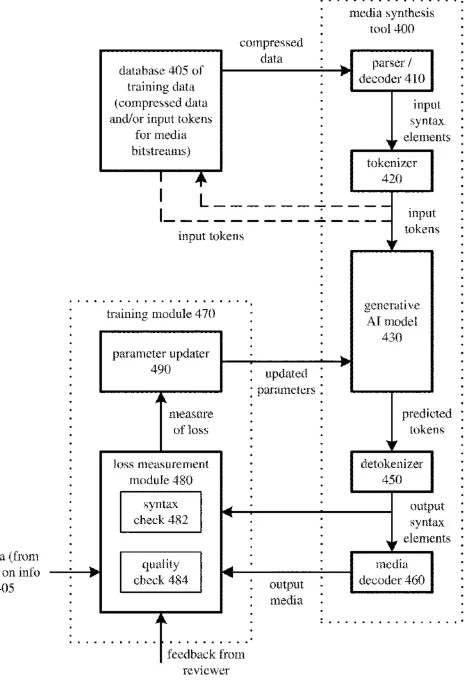
Microsoft describes a system that uses a generative AI model to compress media files by lowering their resolution before encoding. During playback, the AI predicts missing details to reconstruct the original high-resolution image from the compressed data.
In the filing’s own words
A computer system performs operations to compress or decompress media using a generative artificial intelligence (“AI”) model. For compression, a compression tool receives a first version of input media, which has a first resolution, converts the first version to a second version, which has a second resolution lower than the first resolution, compresses the second version, and outputs compressed data for the second version. For decompression, a decompression tool receives input tokens that represent input syntax elements, respectively, of the compressed data for the second version. The decompression tool provides the input tokens to the generative AI model and receives predicted tokens from the generative AI model. The predicted tokens represent output syntax elements, respectively, of compressed data for output media. The decompression tool reconstructs the output media from the predicted tokens. The generative AI model is trained for media compression and decompression using a set of training data.
What exactly they claim (claim 1)
1. Non-transitory computer-readable media having stored thereon computer-executable instructions for causing a processor system, when programmed thereby, to perform operations to compress media using a generative artificial intelligence (“AI”) model, the operations comprising: receiving a first version of input media, the first version having a first resolution; converting the first version to a second version of the input media, the second version having a second resolution; compressing the second version according to a media compression format, thereby producing compressed data for the second version; outputting the compressed data for the second version; receiving input tokens that represent input syntax elements, respectively, of the compressed data for the second version, wherein the input tokens are encoded in an input format for the generative AI model; providing, to the generative AI model, the input tokens; receiving, from the generative AI model, predicted tokens that represent output syntax elements, respectively, of compressed data for output media at the first resolution; reconstructing the output media from the predicted tokens; determining differences between the first version and the output media; compressing the differences, thereby producing compressed data for the differences; and outputting the compressed data for the differences for decompression as an augmentation stream.
Facts
- Company
- Microsoft (Microsoft Technology Licensing, LLC)
- Official title
- MEDIA COMPRESSION AND DECOMPRESSION USING A GENERATIVE ARTIFICIAL INTELLIGENCE MODEL THAT ACCEPTS PARTIALLY DECOMPRESSED DATA AS INPUT
- Publication number
- US20260361899A1
- Application number
- 19747619
- Filed
- Jul 20, 2026
- Published
- Nov 12, 2026
- Inventors
- 2
- Claims
- 20
Classified under
H04N 19/33 Electricity & electronicsH04N 19/31 Electricity & electronicsH04N 19/42 Electricity & electronicsH04N 19/503 Electricity & electronicsH04N 19/593 Electricity & electronicsH04N 19/70 Electricity & electronicsMore from Microsoft in AI & software
- Microsoft patents method to check AI answers against verified facts Oct 20, 2026
- Microsoft patents AI that presents PowerPoint slides for you Sep 3, 2026
- Microsoft patents method to check if LLM answers are based on real data Sep 10, 2026
- Microsoft patents system to blend multiple AI agents into one chat Oct 1, 2026
- Microsoft patents system that answers questions using your screen history Oct 15, 2026
Summaries are simplified from the filing’s own abstract and first claim. A patent filing is not a product announcement.
Patent data and drawings: U.S. Patent and Trademark Office (USPTO). Nebula is not affiliated with or endorsed by the USPTO.