Microsoft patents connector to link superconducting cables to server racks
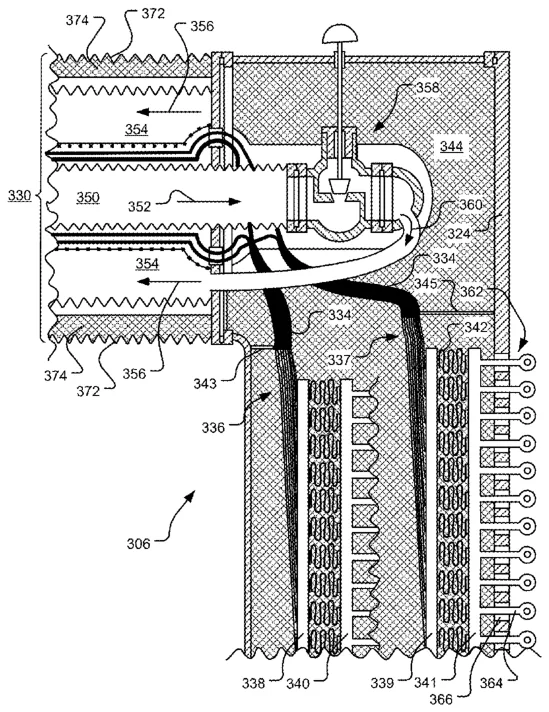
Microsoft describes a device that connects superconducting power cables to standard copper wires in datacenters. It uses a special connector with a vacuum seal and flexible links to keep the cold superconducting material isolated from the warm server hardware.
In the filing’s own words
Compact high-temperature superconducting (HTS) power cables can be used to resolve a power delivery bottleneck caused by high deployment densities of GPU racks within a datacenter. HTS cables are cooled to cryogenic temperatures to achieve an HTS characteristic. However, incorporating a transition from cold HTS cables to warm copper cables for powering GPU racks is challenging. To make good electrical contact, the cross sectional contact area for the transition is maximized. To minimize thermal transfer across the transition, the cross sectional contact area for the transition is minimized. The presently disclosed rack busbar termination device achieves a HTS cable to copper cable connection with a reduced footprint by integrating the termination device with connected rack busbars. A “floating busbar” inside the rack busbar termination device enables an effective thermal isolation of the cryogenically cooled HTS conductors from the connected relatively warm server infrastructure.
What exactly they claim (claim 1)
1. A high-temperature superconducting (HTS) termination comprising: an HTS cable including a first array of conductor ends; a first cold busbar, the first array of conductor ends connected to the first cold busbar; a first warm busbar; a first array of braided links connecting the first cold busbar to the first warm busbar; and a vacuum shell enclosing the first array of conductor ends, the first cold busbar, the first warm busbar, and the first array of braided links.
Facts
- Company
- Microsoft (Microsoft Technology Licensing, LLC)
- Official title
- HIGH-TEMPERATURE SUPERCONDUCTING (HTS) TERMINATION FOR DATACENTER POWER TRANSMISSION
- Publication number
- US20260361008A1
- Application number
- 19205552
- Filed
- May 12, 2025
- Published
- Nov 12, 2026
- Inventors
- 2
- Claims
- 20
Classified under
H01R 4/68 Electricity & electronicsH01B 12/08 Electricity & electronicsH01B 12/16 Electricity & electronicsH01R 13/005 Electricity & electronicsH01R 13/533 Electricity & electronicsH01R 13/645 Electricity & electronicsMore from Microsoft in Chips & hardware
- Microsoft patents DNA builder that adds bases in a chosen order Nov 10, 2026
- Microsoft patents chips with liquid cooling built inside Oct 1, 2026
- Microsoft patents light-based math for faster computing Oct 29, 2026
- Microsoft patents chip design that guesses code steps ahead Sep 8, 2026
- Microsoft patents 3D glass storage using laser light patterns Sep 8, 2026
Summaries are simplified from the filing’s own abstract and first claim. A patent filing is not a product announcement.
Patent data and drawings: U.S. Patent and Trademark Office (USPTO). Nebula is not affiliated with or endorsed by the USPTO.