Microsoft patents method to pick best object detection results
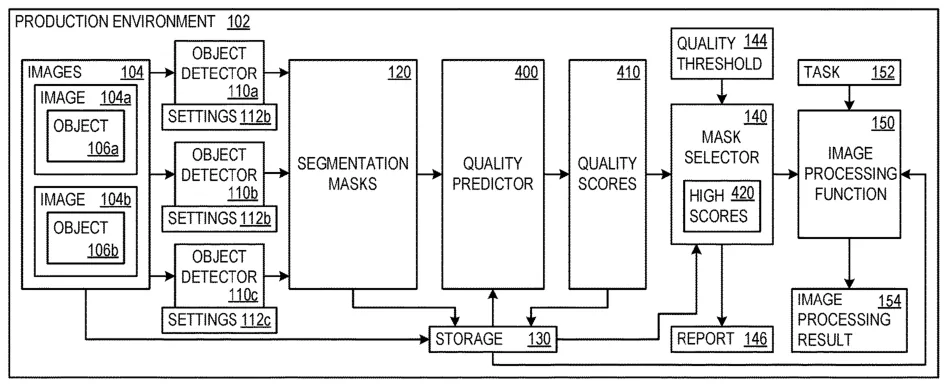
Microsoft describes a system that runs multiple object detection models on an image and uses a quality predictor to score the results. The system then selects the highest-scoring segmentation mask for further image processing tasks without needing human-labeled ground truth data.
In the filing’s own words
Example solutions for ranking object detection results generate or receive a plurality of segmentation masks each corresponding to one or more images. Each segmentation mask of each plurality of segmentation masks is generated using a different object detector or setting options. A quality predictor assigns a quality score to each segmentation mask, without using ground truth for the image(s). A set (one or more, but less than all) of the highest quality scores is identified for each image. In some examples, an image processing task is performed using the segmentation masks having an assigned quality score that is within the set of highest quality scores. In some examples, only the segmentation mask having the highest quality score for an image is used in the image processing task. In some examples, a quality threshold is provided, and the segmentation masks meeting the quality threshold are used in the image processing task.
What exactly they claim (claim 1)
1. A system comprising: a processor; and a computer-readable medium storing instructions that are operative upon execution by the processor to: receive an image, the image including an object; generate, using a first object detector having a first set of operational settings, a first segmentation mask corresponding to the object; generate, using a second object detector, the second object detector different than the first object detector, the second object detector having a second set of operational settings different from the first set of operational settings, a second segmentation mask corresponding to the object; cause a quality predictor to assign a first quality score to the first segmentation mask, wherein the quality predictor comprises a multi-stage vision transformer model having multiple sequential transformer stages and a query head; cause the quality predictor to assign a second quality score to the second segmentation mask based on paired input of the image and the second segmentation mask, wherein the query head outputs a learned Q-vector representing predicted segmentation-mask quality, the quality predictor having been trained using human-provided segmentation-mask quality scores independent of object identity or object count; based on at least the first quality score exceeding the second quality score and the first quality score exceeding a user-specified quality threshold, select the first segmentation mask for an image processing task; and perform the image processing task using the first segmentation mask.
Facts
- Company
- Microsoft (Microsoft Technology Licensing, LLC)
- Official title
- RUNTIME RANKING OF OBJECT DETECTION
- Publication number
- US20260360140A1
- Application number
- 19743507
- Filed
- Jul 15, 2026
- Published
- Nov 12, 2026
- Inventors
- 4
- Claims
- 1
Classified under
G06V 10/993 Physics & computingG06V 10/771 Physics & computingMore from Microsoft in AI & software
- Microsoft patents method to check AI answers against verified facts Oct 20, 2026
- Microsoft patents AI that presents PowerPoint slides for you Sep 3, 2026
- Microsoft patents method to check if LLM answers are based on real data Sep 10, 2026
- Microsoft patents system to blend multiple AI agents into one chat Oct 1, 2026
- Microsoft patents system that answers questions using your screen history Oct 15, 2026
Summaries are simplified from the filing’s own abstract and first claim. A patent filing is not a product announcement.
Patent data and drawings: U.S. Patent and Trademark Office (USPTO). Nebula is not affiliated with or endorsed by the USPTO.