Microsoft patents camera tracking that predicts point paths
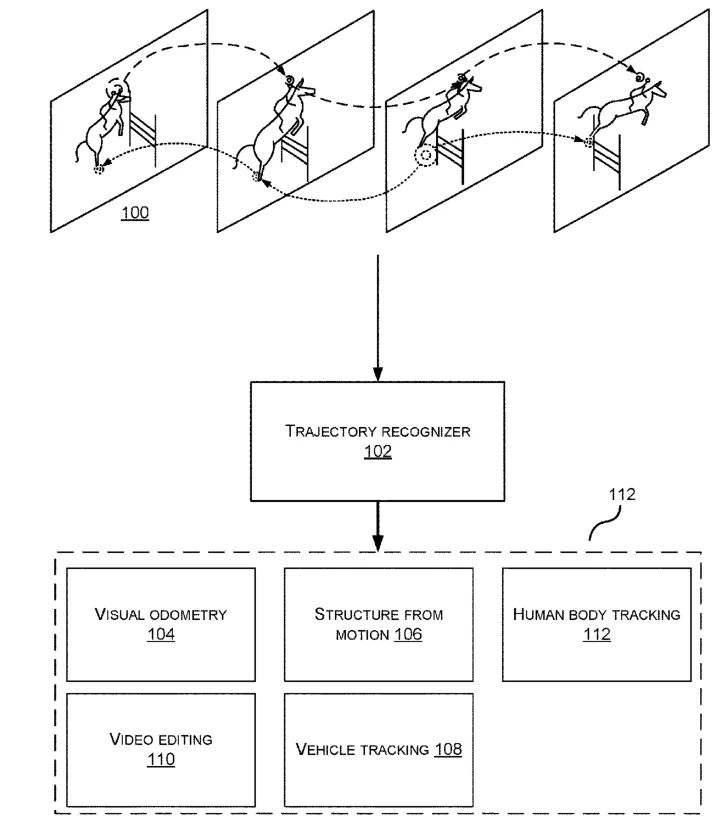
Microsoft describes a method where a neural network tracks specific points across video frames to determine a camera's movement. The system predicts whether each tracked point is on a static or moving object and estimates how visible it remains. This data helps calculate the camera's position and orientation more accurately.
In the filing’s own words
Images captured by a camera moving in an environment are received, and for each of a plurality of points in one of the images, outputs are computed using a neural network. The outputs comprise: a trajectory depicting the point in each of the plurality of images, as well as, for each trajectory, a prediction of visibility of the trajectory in each of the images and a prediction of whether the trajectory depicts a static or moving surface in the environment. The neural network receives the images and points as input and computes the outputs, wherein the outputs comprise for each of the trajectories, confidence data. The outputs are sent to a downstream process selected from any of: visual odometry, structure from motion, human body tracking, video editing, vehicle tracking.
What exactly they claim (claim 1)
1. A computer-implemented method comprising: receiving a plurality of images captured by a camera moving in an environment; computing, using a neural network, a plurality of trajectories for respective points represented in the plurality of images, and confidence data associated with the plurality of trajectories; selecting individual ones of the plurality of trajectories having the confidence data satisfying a threshold; computing a position and orientation of the camera from the individual ones of the plurality of trajectories; and sending the individual ones of the plurality of trajectories to a downstream process.
Facts
- Company
- Microsoft (Microsoft Technology Licensing, LLC)
- Official title
- IMAGE SEQUENCE TRAJECTORIES FOR VISUAL ODOMETRY
- Publication number
- US20260359995A1
- Application number
- 19747799
- Filed
- Jul 20, 2026
- Published
- Nov 12, 2026
- Inventors
- 3
- Claims
- 20
Classified under
G06T 7/246 Physics & computingG06T 5/50 Physics & computingG06T 7/73 Physics & computingG06T 2207/20076 Physics & computingG06T 2207/20084 Physics & computingG06T 2207/30241 Physics & computingMore from Microsoft in AI & software
- Microsoft patents method to check AI answers against verified facts Oct 20, 2026
- Microsoft patents AI that presents PowerPoint slides for you Sep 3, 2026
- Microsoft patents method to check if LLM answers are based on real data Sep 10, 2026
- Microsoft patents system to blend multiple AI agents into one chat Oct 1, 2026
- Microsoft patents system that answers questions using your screen history Oct 15, 2026
Summaries are simplified from the filing’s own abstract and first claim. A patent filing is not a product announcement.
Patent data and drawings: U.S. Patent and Trademark Office (USPTO). Nebula is not affiliated with or endorsed by the USPTO.