Microsoft patents AI system that fixes its own plans when steps fail
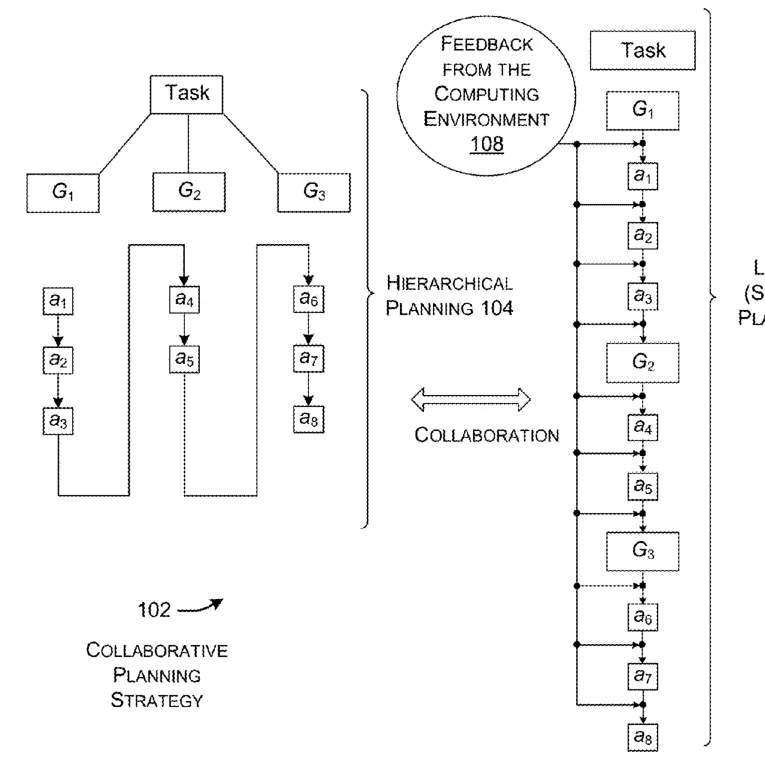
This filing describes a method where two machine-trained models work together to complete tasks. A larger model creates a full plan, while a smaller model executes steps one by one; if a step fails, the larger model creates a new plan to guide the smaller model.
In the filing’s own words
A computer-implemented technique is described that leverages a collaborative interaction between two machine-trained models (“models”) that performs planning using different respective scopes. The first model is a global planning model that generates a global reference plan that specifies a complete set of actions to perform a task. The second model is a local planning model that serially generates actions in a local plan as guided by a current global reference plan. The technique directs the global planning model to generate another global reference plan when an irrecoverable failure is encountered in executing the local plan (based on the first-specified global reference plan). The local planning model subsequently continues its serial generation of actions based on the new global reference plan. A collaboration planning system that includes the local planning model and the global planning model is small enough for successful implementation by a user computing device.
What exactly they claim (claim 1)
1. A method for generating a plan for execution on a computing system, comprising: receiving a request that specifies a task to be performed using the computing system; generating a first global reference plan using a first machine-trained model, the generating including specifying a set of actions that perform the task; serially generating a first local plan using a second machine-trained model by: generating a particular action in the first local plan, as guided by the first global reference plan; executing the particular action by the computing system; verifying whether the executing produces a successful result or an unsuccessful result for the particular action; controlling an operational flow of the method using a program that implements at least two outcomes, including: for the successful result, directing the second machine-trained model to generate, execute, and verify a next action in the first local plan; for the unsuccessful result, directing the first machine-trained model to generate a second global reference plan, and then directing the second machine-trained model to serially generate a second local plan based on the second global reference plan.
Facts
- Company
- Microsoft (Microsoft Technology Licensing, LLC)
- Official title
- Generating a Plan using Collaborating Global and Local Planning Models
- Publication number
- US20260359752A1
- Application number
- 19199668
- Filed
- May 6, 2025
- Published
- Nov 12, 2026
- Inventors
- 7
- Claims
- 20
Classified under
G06Q 10/06316 Physics & computingG06F 9/451 Physics & computingG06F 9/453 Physics & computingG06F 40/35 Physics & computingG06F 16/338 Physics & computingMore from Microsoft in AI & software
- Microsoft patents method to check AI answers against verified facts Oct 20, 2026
- Microsoft patents AI that presents PowerPoint slides for you Sep 3, 2026
- Microsoft patents method to check if LLM answers are based on real data Sep 10, 2026
- Microsoft patents system to blend multiple AI agents into one chat Oct 1, 2026
- Microsoft patents system that answers questions using your screen history Oct 15, 2026
Summaries are simplified from the filing’s own abstract and first claim. A patent filing is not a product announcement.
Patent data and drawings: U.S. Patent and Trademark Office (USPTO). Nebula is not affiliated with or endorsed by the USPTO.