Microsoft patents method to align search retrieval and ranking models
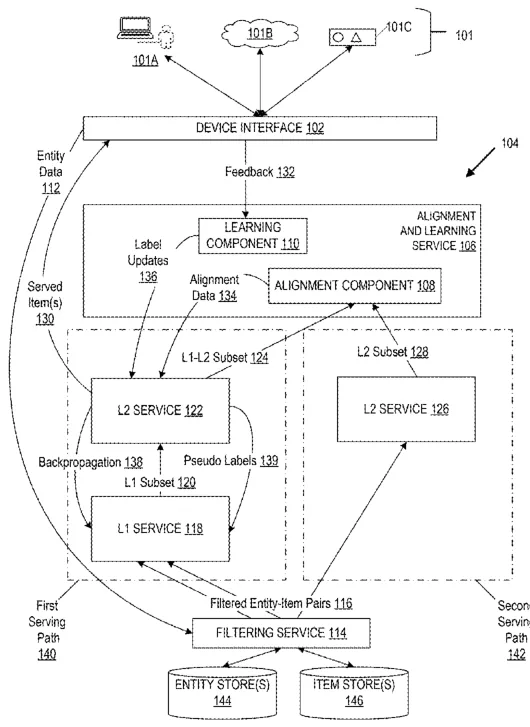
Microsoft describes a system that feeds data through two separate paths to compare how a retrieval model and a ranking model handle the same information. By comparing the outputs of both models, the system calculates an alignment score that is then used to update and improve the retrieval model's performance.
In the filing’s own words
An example provides entity-item pairs to a first machine learning model, receives a first subset of the entity-item pairs from the first machine learning model, provides the first subset to a second machine learning model, and receives first predictive output from the second machine learning model. The first predictive output is generated by the second machine learning model based on the first subset. An example provides the entity-item pairs to the second machine learning model and receives second predictive output from the second machine learning model. The second predictive output is generated by the second machine learning model based on the entity-item pairs. An alignment of a first objective of the first machine learning model with a second objective of the second machine learning model is computed using the first predictive output and the second predictive output. The alignment may be used to update the first machine learning model.
What exactly they claim (claim 1)
1. A method comprising: providing entity-item pairs to a first serving path and a second serving path, wherein the first serving path and the second serving path independently process the entity-item pairs; via a first serving path, (i) providing the entity-item pairs to a retrieval machine learning model, (ii) receiving a first subset of the entity-item pairs from the retrieval machine learning model, (iii) providing the first subset of the entity-item pairs to a ranking machine learning model, and (iv) receiving first predictive output from the ranking machine learning model, wherein the first predictive output is generated by the ranking machine learning model from the first subset of the entity-item pairs; via a second serving path, (i) providing the entity-item pairs to the ranking machine learning model, (ii) receiving second predictive output from the ranking machine learning model, wherein the second predictive output is generated by the ranking machine learning model from the entity-item pairs, and (iii) storing the second predictive output in memory; retrieving the second predictive output from the memory; computing an alignment of a retrieval objective of the retrieval machine learning model with a ranking objective of the ranking machine learning model based on a comparison of the first predictive output generated from the first subset of the entity-item pairs and the retrieved second predictive output generated from the entity-item pairs; and using the alignment to update the retrieval machine learning model.
Facts
- Company
- Microsoft (Microsoft Technology Licensing, LLC)
- Official title
- RETRIEVAL AND RANKING WITH AUTOMATIC ALIGNMENT
- Publication number
- US20260359314A1
- Application number
- 19204389
- Filed
- May 9, 2025
- Published
- Nov 12, 2026
- Inventors
- 10
- Claims
- 20
Classified under
G06F 16/248 Physics & computingG06N 20/00 Physics & computingMore from Microsoft in AI & software
- Microsoft patents method to check AI answers against verified facts Oct 20, 2026
- Microsoft patents AI that presents PowerPoint slides for you Sep 3, 2026
- Microsoft patents method to check if LLM answers are based on real data Sep 10, 2026
- Microsoft patents system to blend multiple AI agents into one chat Oct 1, 2026
- Microsoft patents system that answers questions using your screen history Oct 15, 2026
Summaries are simplified from the filing’s own abstract and first claim. A patent filing is not a product announcement.
Patent data and drawings: U.S. Patent and Trademark Office (USPTO). Nebula is not affiliated with or endorsed by the USPTO.