Google patents smarter memory layout for easier device debugging
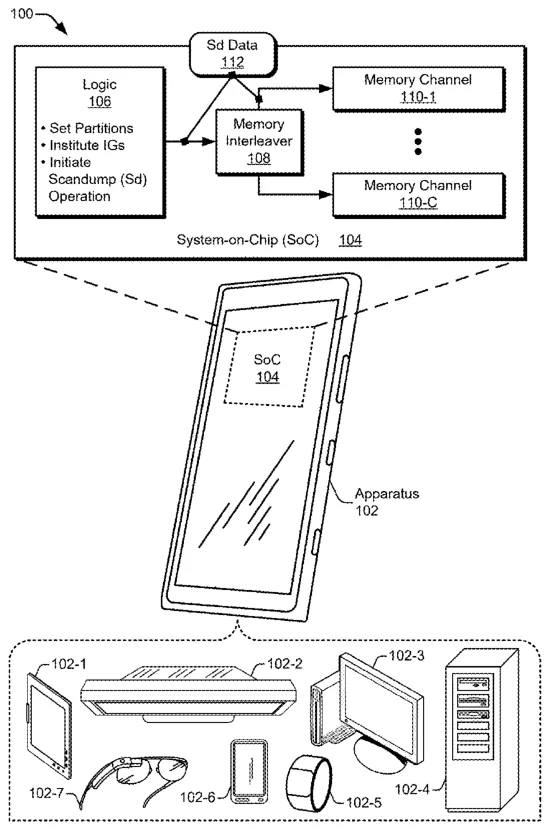
This filing describes a method for organizing a device's memory into two distinct zones with different data-splitting rules. By creating a specific zone with a larger data block size, the system can store diagnostic data in a single memory channel without mixing it with other channels. This makes it easier for engineers to retrieve that data for troubleshooting without needing special external hardware.
In the filing’s own words
Typically, scandump data for debugging efforts is obtained from an integrated circuit using specialized testing equipment, which is infeasible for a deployed electronic device. Instead, the scandump data can be stored in a local memory of the device. If the device interleaves data across multiple memory channels, however, extraction of the scandump data becomes riskier or more difficult. Further, interleaving scandump data can waste 75% of the reserved memory space (e.g., with four memory channels). To enhance a scandump operation in a memory interleaving environment, memory is partitioned into first and second regions with different first and second interleaving granularities (IGs). The first IG is sufficiently large to encompass targeted scandump data. Accordingly, a memory interleaver can transfer the scandump data to the memory of one memory channel without interleaving based on a first-region segment allocated to the one memory channel. Other first-region segments can be used for other purposes.
What exactly they claim (claim 1)
1. A method for implementing a scandump operation using at least one memory channel, the method comprising: partitioning a logical address space into a first region and a second region; instituting a first interleaving granularity for the first region and a second interleaving granularity for the second region, the first interleaving granularity different from the second interleaving granularity; partitioning the first region into multiple first-region segments, each respective first-region segment of the multiple first-region segments corresponding to a respective memory channel of multiple memory channels; assigning a first first-region segment of the multiple first-region segments to a first memory channel of the multiple memory channels; and transferring scandump data to the first memory channel based on the first first-region segment and in accordance with the first interleaving granularity.
Facts
- Company
- Google (Google LLC)
- Official title
- Enhanced Memory-Channel-Focused Scandump
- Publication number
- US20260358414A1
- Application number
- 19201534
- Filed
- May 7, 2025
- Published
- Nov 12, 2026
- Inventors
- 3
- Claims
- 20
Classified under
G01R 31/318544 Physics & computingG01R 31/31705 Physics & computingG01R 31/318558 Physics & computingMore from Google in Chips & hardware
- Google patents radar network to track users across multiple devices Nov 10, 2026
- Google patents quantum gates to simulate particle physics Sep 1, 2026
- Waymo patents lidar chips that split light into multiple beams Sep 8, 2026
- Google patents chip design to speed up AI math tasks Sep 8, 2026
- Google patents display that turns off colors to save battery Sep 8, 2026
Summaries are simplified from the filing’s own abstract and first claim. A patent filing is not a product announcement.
Patent data and drawings: U.S. Patent and Trademark Office (USPTO). Nebula is not affiliated with or endorsed by the USPTO.