Microsoft patents summaries that fact-check themselves against trusted sources

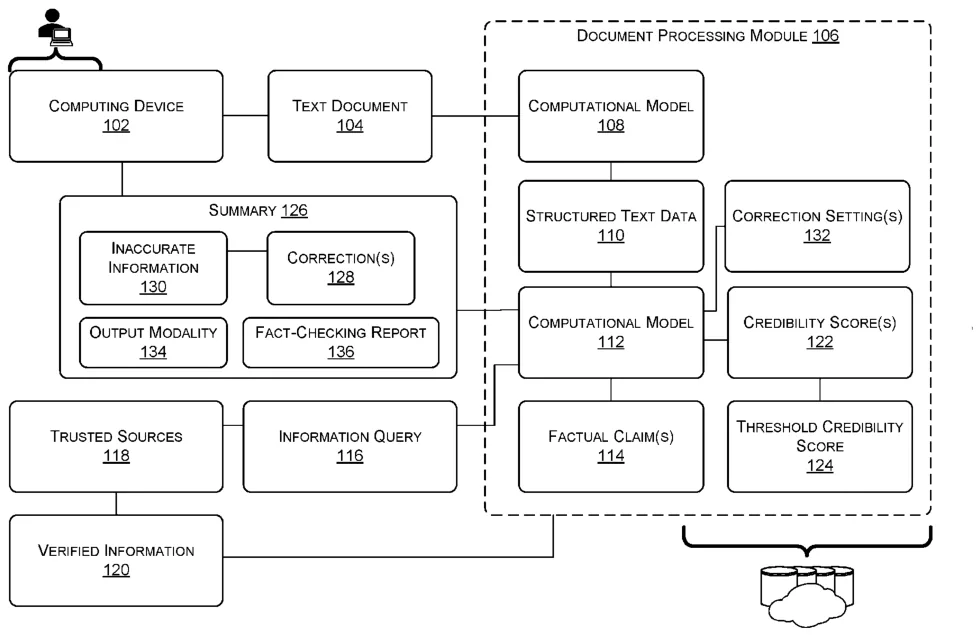
Microsoft describes a system that checks the accuracy of AI-generated summaries by comparing them against verified data from trusted sources. If a statement in the summary is found to be inaccurate, the system automatically corrects it and highlights the change for the user.
In the filing’s own words
The techniques discussed herein are directed to real-time information checking when generating summaries of text documents. Generative artificial intelligence productivity tools are often used for summarizing content such a long text documents (e.g., research papers, legal filings, meeting transcripts). However, many existing artificial intelligence systems lack mechanisms for ensuring the content of the summaries they generate is accurate and/or complete. Consequently, this lack of functionality can lead to the propagation of inaccurate and/or misleading information as well as a disjointed, confusing user experience. To address this technical challenge, the present system and method provides mechanisms that enable generative artificial intelligence models to check the accuracy and/or completeness of information within text documents using a semantic comparison against information from trusted sources such as research institution databases. Moreover, the system provides functionality for seamlessly incorporating corrections into summaries to inform users of potentially inaccurate and/or incomplete information.
What exactly they claim (claim 1)
1. A method for fact-checking while synthesizing a summary of a text document, the method comprising: receiving, from a computing device, an upload of the text document for summarization; in response to receiving the upload of the text document, extracting, by execution of a first computational model, structured text data from the text document; identifying, by execution of a second computational model, a factual claim conveyed by the structured text data of the text document; deploying an information query to a plurality of trusted sources based on the factual claim to retrieve verified information corresponding to the factual claim; calculating, by execution of the second computational model, a credibility score for the factual claim based on a semantic similarity comparison against the verified information corresponding to the factual claim; determining that the credibility score does not satisfy a threshold credibility score indicating that the factual claim contains inaccurate information; in response to determining that the credibility score does not satisfy the threshold credibility score, synthesizing the summary of the text document, wherein the summary incorporates a correction to the factual claim in accordance with the verified information retrieved via the information query; and delivering the summary of the text document to the computing device, wherein the summary includes a fact-checking report identifying the inaccurate information, the correction in accordance with the verified information that is graphically distinguished from the inaccurate information, and at least one of the plurality of trusted sources.
Facts
- Company
- Microsoft (MICROSOFT TECHNOLOGY LICENSING, LLC)
- Official title
- AUTOMATED INFORMATION CHECKING IN SYNTHESIZED TEXT DOCUMENT SUMMARIES
- Publication number
- US20260340262A1
- Application number
- 19188810
- Filed
- Apr 24, 2025
- Published
- Oct 29, 2026
- Inventors
- 1
- Claims
- 20
Classified under
G06F 40/166 Physics & computingG06F 40/30 Physics & computingMore from Microsoft in AI & software
- Microsoft patents method to check AI answers against verified facts Oct 20, 2026
- Microsoft patents AI that presents PowerPoint slides for you Sep 3, 2026
- Microsoft patents method to check if LLM answers are based on real data Sep 10, 2026
- Microsoft patents system to blend multiple AI agents into one chat Oct 1, 2026
- Microsoft patents system that answers questions using your screen history Oct 15, 2026
Summaries are simplified from the filing’s own abstract and first claim. A patent filing is not a product announcement.
Patent data and drawings: U.S. Patent and Trademark Office (USPTO). Nebula is not affiliated with or endorsed by the USPTO.