Microsoft patents smarter video compression by adjusting motion tracking precision
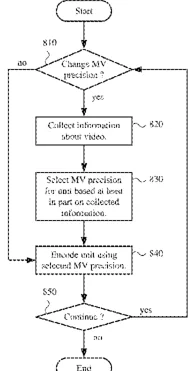
This patent describes a method for video encoders to choose how precisely to track movement between frames. The system tests different levels of detail, such as whole numbers or fractions of a pixel, to find the best balance between file size and image quality.
In the filing’s own words
Approaches to selection of motion vector (“MV”) precision during video encoding are presented. These approaches can facilitate compression that is effective in terms of rate-distortion performance and/or computational efficiency. For example, a video encoder determines an MV precision for a unit of video from among multiple MV precisions, which include one or more fractional-sample MV precisions and integer-sample MV precision. The video encoder can identify a set of MV values having a fractional-sample MV precision, then select the MV precision for the unit based at least in part on prevalence of MV values (within the set) having a fractional part of zero. Or, the video encoder can perform rate-distortion analysis, where the rate-distortion analysis is biased towards the integer-sample MV precision. Or, the video encoder can collect information about the video and select the MV precision for the unit based at least in part on the collected information.
What exactly they claim (claim 1)
1. One or more non-transitory computer-readable media having stored therein computer-executable instructions for causing one or more processing units, when programmed thereby, to perform operations comprising: encoding frames of a video sequence, thereby producing encoded data, wherein the encoding the frames includes: setting an indicator, the indicator indicating (a) whether or not motion vector (“MV”) precision is adaptively selected for units of the video sequence, and (b) if the MV precision for the units is not adaptively selected, whether the MV precision for the units is fractional-sample precision or integer-sample precision; encoding the indicator in a first-layer syntax structure that applies for the video sequence, wherein the indicator indicates the MV precision for the units is adaptively selected; and for a current unit among the units: selecting whether MV precision for the current unit is the fractional-sample precision or the integer-sample precision, wherein the selecting includes: performing rate-distortion analysis to evaluate encoding of the current unit with the MV precision being the integer-sample precision and to evaluate encoding of the current unit with the MV precision being the fractional-sample precision; and based at least in part on results of the rate-distortion analysis, determining whether the MV precision for the current unit is the fractional-sample precision or the integer-sample precision; and encoding a flag in a second-layer syntax structure for the current unit, the flag indicating the MV precision for the current unit to be the fractional-sample precision or the integer-sample precision; and outputting the encoded data as part of a bitstream, the encoded data including the encoded indicator in the first-layer syntax structure and, the MV precision for the units being adaptively selected, the flag in the second-layer syntax structure for the current unit that indicates the MV precision for the current unit.
Facts
- Company
- Microsoft (Microsoft Technology Licensing, LLC)
- Official title
- Selection of motion vector precision
- Patent number
- US12804167B2
- Application number
- 18808958
- Filed
- Aug 19, 2024
- Granted
- Nov 17, 2026
- Inventors
- 3
- Claims
- 20
Classified under
H04N 19/174 Electricity & electronicsH04N 19/105 Electricity & electronicsH04N 19/109 Electricity & electronicsH04N 19/136 Electricity & electronicsH04N 19/139 Electricity & electronicsH04N 19/142 Electricity & electronicsMore from Microsoft in AI & software
- Microsoft patents method to check AI answers against verified facts Oct 20, 2026
- Microsoft patents AI that presents PowerPoint slides for you Sep 3, 2026
- Microsoft patents method to check if LLM answers are based on real data Sep 10, 2026
- Microsoft patents system to blend multiple AI agents into one chat Oct 1, 2026
- Microsoft patents system that answers questions using your screen history Oct 15, 2026
Summaries are simplified from the filing’s own abstract and first claim. A patent filing is not a product announcement.
Patent data and drawings: U.S. Patent and Trademark Office (USPTO). Nebula is not affiliated with or endorsed by the USPTO.