Microsoft patents search method that blends concepts with background knowledge
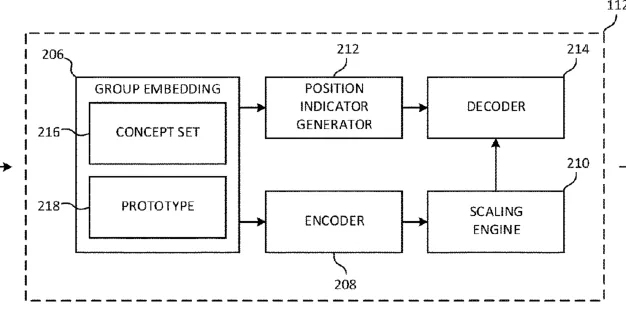
Microsoft describes a system that improves search results by combining user queries with a 'prototype' drawn from a large knowledge base. The model adjusts the weight of these background details to ensure the final answer fits the specific context of the search, rather than relying only on the words in the query.
In the filing’s own words
A knowledge injection model for generative commonsense reasoning. In examples, an encoder-decoder model is used to generate a model output ( 204) a plausible description for a set of concepts. A prototype ( 218) is generated from an in-domain or out-of-domain knowledge corpus, which is further used as input ( 202) for the encoder-decoder model. Concept input tokens and prototype input tokens are scaled to limit potential skew that may be introduced by the prototype ( 218). Additionally, position indicators are generated for each input token, which indicate the relative position each respective input token as compared to other input tokens. As such, when decoding the scaled encoded input tokens, the decoder ( 214) may be more attuned to the scenario bias that is introduced by the prototype ( 218) when generating a model output ( 204). Thus, the encoder-decoder model need not rely solely on the set of concepts when generating the model output ( 204).
What exactly they claim (claim 1)
1. A system comprising: at least one processor; and memory storing instructions that, when executed by the at least one processor, causes the system to perform a set of operations, the set of operations comprising: receiving an indication comprising a search query from a computing device; obtaining, based on a knowledge corpus, a prototype for a set of concepts associated with the search query; encoding an input based on the set of concepts and the obtained prototype, the input comprising one or more concept input tokens for the set of concepts and one or more prototype input tokens for the obtained prototype; scaling the encoded input to decrease a first norm for an encoded output state of a first prototype input token that is similar to a first concept input token of the concept input tokens; generating a set of position indicators for input tokens of the input; decoding the scaled encoded output based on the set of position indicators to generate a model output; identifying, based on the generated model output, targeted content; and providing, to the computing device, the identified targeted content in response to the received indication.
Facts
- Company
- Microsoft (Microsoft Technology Licensing, LLC)
- Official title
- Knowledge injection model for generative commonsense reasoning
- Patent number
- US12801948B2
- Application number
- 18035849
- Filed
- Nov 12, 2020
- Granted
- Nov 17, 2026
- Inventors
- 6
- Claims
- 20
Classified under
G06N 5/04 Physics & computingG06N 5/02 Physics & computingG06N 5/022 Physics & computingMore from Microsoft in AI & software
- Microsoft patents method to check AI answers against verified facts Oct 20, 2026
- Microsoft patents AI that presents PowerPoint slides for you Sep 3, 2026
- Microsoft patents method to check if LLM answers are based on real data Sep 10, 2026
- Microsoft patents system to blend multiple AI agents into one chat Oct 1, 2026
- Microsoft patents system that answers questions using your screen history Oct 15, 2026
Summaries are simplified from the filing’s own abstract and first claim. A patent filing is not a product announcement.
Patent data and drawings: U.S. Patent and Trademark Office (USPTO). Nebula is not affiliated with or endorsed by the USPTO.