Nvidia patents system to rate how much a car's sensors can trust their own data
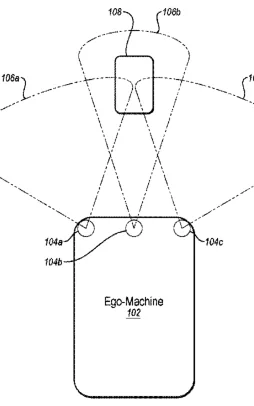
Nvidia describes a method for self-driving or automated machines to assess the reliability of their camera and radar inputs. The system breaks the view into small sections and assigns a confidence score to each part based on issues like dirt, glare, or blocked views. The machine then adjusts its driving actions or alerts based on how trustworthy that specific part of the view is.
In the filing’s own words
Embodiments of the present disclosure may include a method and system for performing one or more operations based on a visibility confidence model. In some embodiments, the method may include generating a visibility confidence model which may indicate a level of confidence in sensor data that may correspond to individual sub-sections of an aggregate field of view. In some embodiments, the levels of confidence may be determined based on one or more errors associated with an individual sensor, one or more gross-level degradations, one or more fine-level degradations, or one or more occlusions being present in the sensor data. In some embodiments, the method may additionally include performing one or more operations based on the visibility confidence model or the level of confidence corresponding to individual sub-areas of the aggregate field of view.
What exactly they claim (claim 1)
1. A method comprising: determining a plurality of visibility determinations individually corresponding to individual sub-sections of an aggregate field of view of a plurality of sensors of a plurality of sensor modalities of a machine; determining, based at least on the plurality of visibility determinations, a plurality of visibility confidence models corresponding to the plurality of sensors, individual visibility confidence models of the plurality of visibility confidence models corresponding to individual sensors of the plurality of sensors and respectively indicating individual levels of confidence in sensor data corresponding to respective sensors; generating, based at least on the plurality of visibility confidence models, an aggregate visibility confidence model corresponding to the aggregate field of view, the aggregate visibility confidence model indicating a level of confidence in sensor data corresponding to each individual sub-section of the aggregate field of view; and performing or adjusting performance of one or more operations of the machine based at least on the aggregate visibility confidence model or the level of confidence corresponding to the individual sub-sections of the aggregate field of view.
Facts
- Company
- Nvidia (NVIDIA Corporation)
- Official title
- Perception confidence
- Patent number
- US12780242B2
- Application number
- 18391334
- Filed
- Dec 20, 2023
- Granted
- Nov 3, 2026
- Inventors
- 4
- Claims
- 20
Classified under
B60W 60/001 Operations & transportB60W 50/0205 Operations & transportB60W 2050/0215 Operations & transportB60W 2420/403 Operations & transportB60W 2556/10 Operations & transportMore from Nvidia in Cars & transport
- Nvidia patents robotaxi system with AI dispatcher and virtual rails Sep 15, 2026
- Nvidia patents car drowsiness check that uses your body clock Oct 13, 2026
- Nvidia patents 3D camera system to measure passengers in vehicles Oct 13, 2026
- Nvidia patents cruise control that predicts driver's next move Oct 20, 2026
- Nvidia patents dual-brain system for self-driving cars Sep 17, 2026
Summaries are simplified from the filing’s own abstract and first claim. A patent filing is not a product announcement.
Patent data and drawings: U.S. Patent and Trademark Office (USPTO). Nebula is not affiliated with or endorsed by the USPTO.