Nvidia patents car drowsiness check that uses your body clock
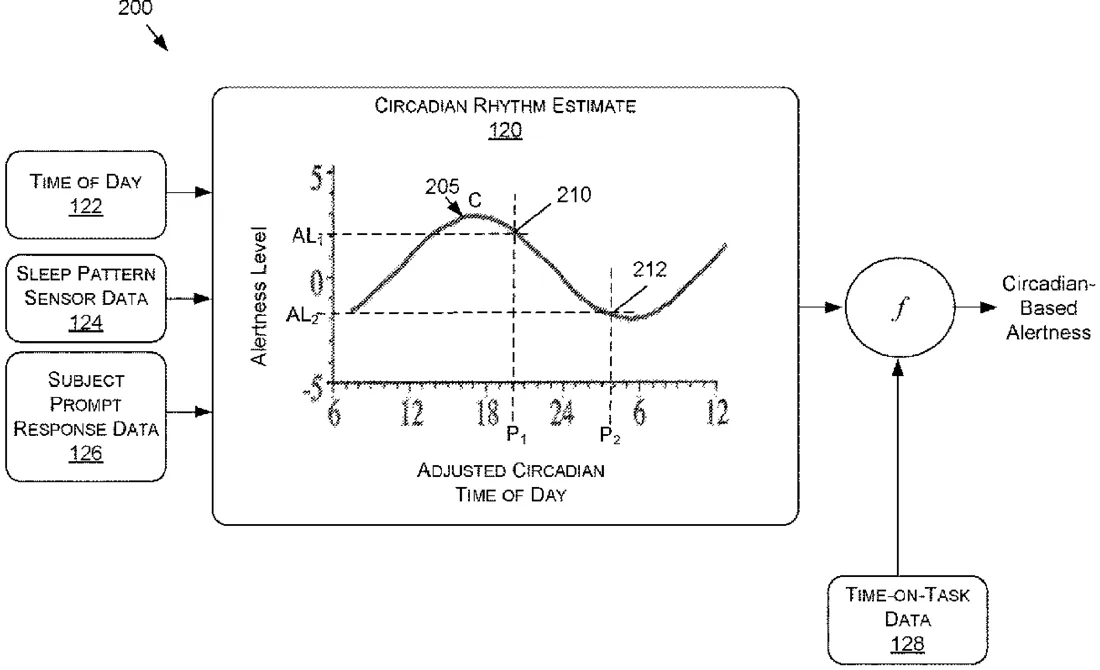
Nvidia describes a system for cars that estimates a driver's natural body clock, or circadian rhythm, to improve drowsiness detection. By combining this biological timing with video data, the system can correct or replace standard drowsiness scores to better predict when a driver is tired. The patent explains how this method can also help create better training data for the computer models used in these safety systems.
In the filing’s own words
In various examples, circadian rhythm-based data augmentation for drowsiness detection systems and applications are provided. Embodiments described herein may produce an estimated circadian rhythm for a test subject and/or vehicle driver or other machine operator or occupant, and use the pattern of that circadian rhythm to correct, confirm, calibrate, or otherwise augment drowsiness assessments derived from video image data. The position of a person in the context of their process C circadian cycle may be used as indication of their level of drowsiness. An estimated process C circadian cycle may be used to generate more accurate ground truth training data for training machine learning models, and may be used by real-time, in-vehicle drowsiness detection systems that infer driver drowsiness levels based on captured images. In various embodiments, a circadian rhythm drowsiness estimate may be used to correct, calibrate, augment, and/or replace a drowsiness score predicted by a machine learning model.
What exactly they claim (claim 1)
1. One or more processors comprising one or more processing units to: receive image sensor data comprising an image sequence representing an occupant of a machine; compute a drowsiness score estimate for the occupant based at least on correlating a circadian rhythm process to the occupant; generate a drowsiness score indication associated with the occupant based at least on one or more of a correction, replacement, or calibration of an inferred drowsiness score of the occupant determined from the image sensor data based at least on the drowsiness score estimate; and adjust an operation of the machine based at least on the drowsiness score indication.
Facts
- Company
- Nvidia (NVIDIA Corporation)
- Official title
- Circadian rhythm-based data augmentation for occupant state analysis
- Patent number
- US12759561B2
- Application number
- 18408336
- Filed
- Jan 9, 2024
- Granted
- Oct 13, 2026
- Inventors
- 5
- Claims
- 20
Classified under
B60W 40/08 Operations & transportB60W 50/0097 Operations & transportB60W 50/0098 Operations & transportG06V 10/34 Physics & computingG06V 20/597 Physics & computingG06V 40/10 Physics & computingMore from Nvidia in Cars & transport
- Nvidia patents robotaxi system with AI dispatcher and virtual rails Sep 15, 2026
- Nvidia patents 3D camera system to measure passengers in vehicles Oct 13, 2026
- Nvidia patents cruise control that predicts driver's next move Oct 20, 2026
- Nvidia patents dual-brain system for self-driving cars Sep 17, 2026
- Nvidia patents method for self-driving cars to see around corners Sep 17, 2026
Summaries are simplified from the filing’s own abstract and first claim. A patent filing is not a product announcement.
Patent data and drawings: U.S. Patent and Trademark Office (USPTO). Nebula is not affiliated with or endorsed by the USPTO.