Nvidia patents cruise control that predicts driver's next move
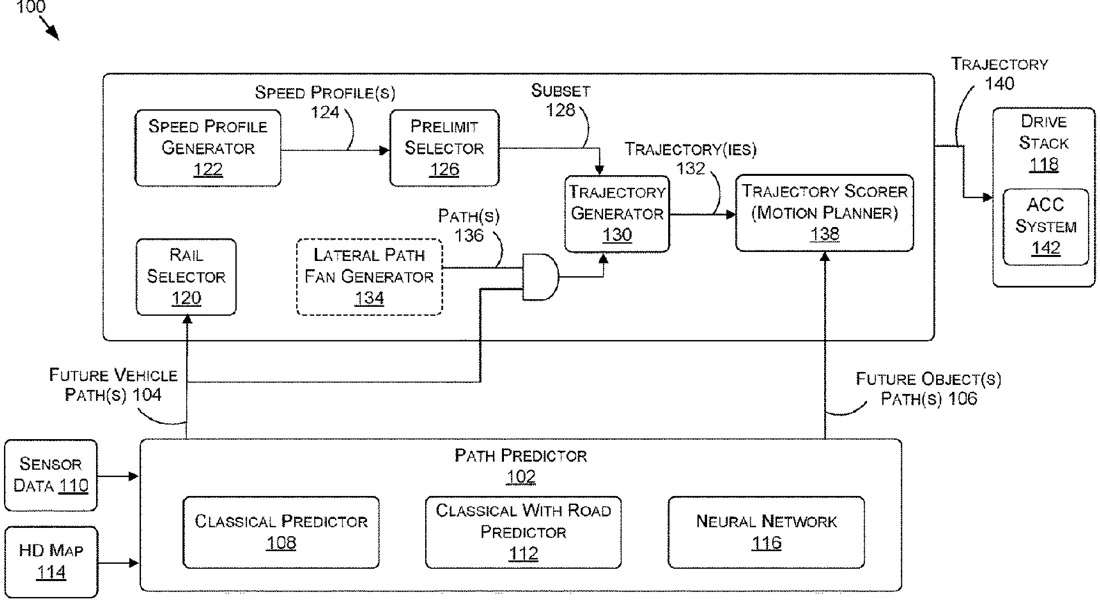
This patent describes a system where a car's adaptive cruise control predicts the path a driver is likely to take, such as switching lanes or staying in the current lane. It calculates the speed needed for each possible path and adjusts the car's speed based on which path the driver actually chooses.
In the filing’s own words
In various examples, techniques for using future trajectory predictions for adaptive cruise control (ACC) are described. For instance, a vehicle may determine a future path(s) of the vehicle and a future path(s) of an object(s). The vehicle may then use a speed profile(s) and the future path(s) to determine a trajectory(ies) for the vehicle. The vehicle may then select a trajectory, such as based on the future path(s) of the object(s). Based on the trajectory, ACC of the vehicle may cause the vehicle to navigate at a speed or a velocity. This way, the vehicle is able to continue using ACC even when the driver makes a maneuver(s) or the system determined to make a maneuver, such as switching lanes or choosing a lane when a road splits.
What exactly they claim (claim 1)
1. A processor comprising: processing circuitry to: receive, while an ego-machine is navigating using an adaptive cruise control (ACC) system where steering of the ego-machine is being controlled by a user, one or more user inputs for updating one or more preferences corresponding to the ACC system; determine, while the ego-machine is navigating using the ACC system and based on data associated with at least one of the ego-machine or an environment the ego-machine is navigating, a first future path that the user may control the ego-machine to navigate within the environment and a second future path that the user may control the ego-machine to navigate within the environment; determine, while the ego-machine is navigating using the ACC system and based at least on applying a first speed profile that is selected using the one or more preferences to the first future path that the user may control the ego-machine to navigate, a first future trajectory for the ego-machine to navigate, the first future trajectory including a first longitudinal that is based at least on a first velocity associated with the first speed profile; determine, while the ego-machine is navigating using the ACC system and based at least on applying a second speed profile that is selected using the one or more preferences and to the second future path that the user may control the ego-machine to navigate, a second future trajectory for the ego-machine to navigate, the second future trajectory including a second longitudinal distance that is based at least on a second velocity associated with the second speed profile; and cause, using the ACC system, the ego-machine to navigate according to the first velocity based at least on the user controlling the ego-machine to navigate along the first future trajectory rather than the second future trajectory.
Facts
- Company
- Nvidia (NVIDIA Corporation)
- Official title
- Adaptive cruise control using future trajectory prediction for autonomous systems and applications
- Patent number
- US12767132B2
- Application number
- 17891587
- Filed
- Aug 19, 2022
- Granted
- Oct 20, 2026
- Inventors
- 7
- Claims
- 21
Classified under
B60W 30/14 Operations & transportB60W 50/0097 Operations & transportB60W 60/001 Operations & transportB60W 2520/00 Operations & transportB60W 2556/00 Operations & transportMore from Nvidia in Cars & transport
- Nvidia patents robotaxi system with AI dispatcher and virtual rails Sep 15, 2026
- Nvidia patents car drowsiness check that uses your body clock Oct 13, 2026
- Nvidia patents 3D camera system to measure passengers in vehicles Oct 13, 2026
- Nvidia patents dual-brain system for self-driving cars Sep 17, 2026
- Nvidia patents method for self-driving cars to see around corners Sep 17, 2026
Summaries are simplified from the filing’s own abstract and first claim. A patent filing is not a product announcement.
Patent data and drawings: U.S. Patent and Trademark Office (USPTO). Nebula is not affiliated with or endorsed by the USPTO.