Nvidia patents method to speed up 3D neural network training
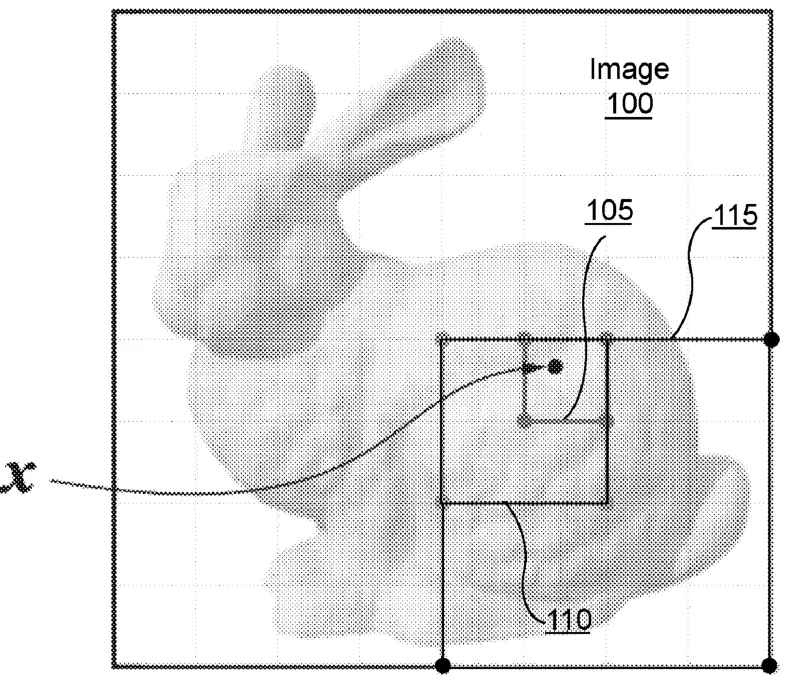
Nvidia describes a technique that converts 3D coordinates into a compact code using a hash function before feeding them into a neural network. By processing these coordinates at different levels of detail and combining the results, the system can look up pre-learned data more efficiently. This approach aims to make training neural networks for 3D data faster and more accurate.
In the filing’s own words
Neural network performance is improved in terms of training speed and/or accuracy by encoding (mapping) inputs to the neural network into a higher dimensional space via a hash function. The input comprises coordinates used to identify a point within a d-dimensional space (e.g., 3D space). The point is quantized and a set of vertex coordinates corresponding to the point are input to a hash function. For example, for d=3, space may be partitioned into axis-aligned voxels of identical size and vertex coordinates of a voxel containing the point are input to the hash function to produce a set of encoded coordinates. The set of encoded coordinates is used to lookup D-dimensional feature vectors in a table of size T that have been learned. The learned feature vectors are filtered (e.g., linearly interpolated, etc.) based on the coordinates of the point to compute a feature vector corresponding to the point.
What exactly they claim (claim 1)
1. A computer-implemented method for mapping multi-dimensional input coordinates to a feature vector for input to a neural network model, comprising: processing the multi-dimensional input coordinates to produce first encoded coordinates for a first resolution level; processing the multi-dimensional input coordinates to produce second encoded coordinates for a second resolution level; obtaining a first feature vector stored at a first entry of a first table, wherein the first entry is associated with the first encoded coordinates; obtaining a second feature vector stored at a second entry of a second table, wherein the second entry is associated with the second encoded coordinates; concatenating the first feature vector and the second feature vector to produce a concatenated feature vector; and inputting the concatenated feature vector to the neural network model to generate a prediction of task-specific data at the multi-dimensional input coordinates.
Facts
- Company
- Nvidia (NVIDIA Corporation)
- Official title
- MULTIRESOLUTION HASH ENCODING FOR NEURAL NETWORKS
- Publication number
- US20260359633A1
- Application number
- 19740672
- Filed
- Jul 14, 2026
- Published
- Nov 12, 2026
- Inventors
- 10
- Claims
- 20
Classified under
G06N 3/08 Physics & computingG06N 3/02 Physics & computingMore from Nvidia in AI & software
- Nvidia patents AI coach that analyzes your gameplay to suggest strategies Oct 13, 2026
- Nvidia patents AI system that writes and voices character conversations Sep 10, 2026
- Nvidia patents system that uses AI to find bugs in game videos Sep 17, 2026
- Nvidia patents chip that turns text into video using noise reduction Nov 5, 2026
- Nvidia patents system that translates specific speakers in group conversations Nov 12, 2026
Summaries are simplified from the filing’s own abstract and first claim. A patent filing is not a product announcement.
Patent data and drawings: U.S. Patent and Trademark Office (USPTO). Nebula is not affiliated with or endorsed by the USPTO.