Google patents audio compression that mimics human hearing
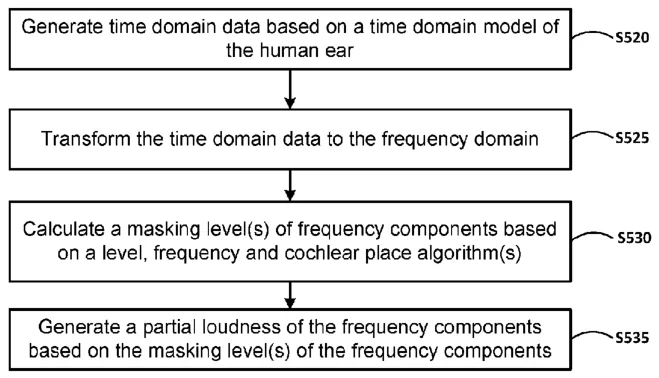
Google describes a method for compressing audio files that checks how the sound would be perceived by the human ear before finalizing the data. The system uses a model based on how the inner ear processes sound to adjust the compression level, ensuring that important details are not lost during the process.
In the filing’s own words
A method including receiving a plurality of audio channels based on an audio stream, applying a model based on at least one acoustic perception algorithm to the plurality of audio channels to generate a first modelled audio stream, quantizing the plurality of audio channels using a first set of quantization parameters, dequantizing the quantized plurality of audio channels using the first set of quantization parameters, applying the model based on at least one acoustic perception algorithm to the dequantized plurality of audio channels to generate a second modelled audio stream, comparing the first modelled audio stream and the second modelled audio stream, in response to determining the comparison of the first modelled audio stream and the second modelled audio stream does not meet a criterion, generating a second set of quantization parameters, and quantizing the plurality of audio channels using the second set of quantization parameters.
What exactly they claim (claim 1)
1. A method comprising: receiving a plurality of audio channels based on an audio stream; applying a model based on at least one acoustic perception algorithm based on a frequency, a level, and a cochlear place algorithm applied to the plurality of audio channels in the frequency domain to generate a first modelled audio stream; quantizing the plurality of audio channels using a first set of quantization parameters; dequantizing the quantized plurality of audio channels using the first set of quantization parameters; applying the model based on at least one acoustic perception algorithm to the dequantized plurality of audio channels to generate a second modelled audio stream; determining a difference in perception by comparing the first modelled audio stream and the second modelled audio stream; in response to determining the difference does not meet a criterion, generating a second set of quantization parameters configured to reduce compression relative to the first set of quantization parameters to change a qualitative impact of quantization; and quantizing the plurality of audio channels using the second set of quantization parameters.
Facts
- Company
- Google (GOOGLE LLC)
- Official title
- Maintaining invariance of sensory dissonance and sound localization cues in audio codecs using an acoustic perception algorithm modeled on cochlear
- Patent number
- US12802697B2
- Application number
- 18000443
- Filed
- Aug 28, 2020
- Granted
- Nov 17, 2026
- Inventors
- 2
- Claims
- 18
Classified under
G10L 19/032 Physics & computingG10L 15/20 Physics & computingG10L 19/008 Physics & computingH03M 13/6312 Electricity & electronicsG10L 19/0017 Physics & computingG10L 19/0208 Physics & computingMore from Google in Audio & voice
- Google patents voice assistant that cuts off its own answer to hear a new question Sep 15, 2026
- Google patents system to create sound effects from text descriptions Nov 3, 2026
- Google patents head-worn device that cleans up voice using bone vibration Sep 17, 2026
- Google patents voice assistant that asks before acting on commands Sep 1, 2026
- Google patents voice shortcuts that only work for registered users Oct 27, 2026
Summaries are simplified from the filing’s own abstract and first claim. A patent filing is not a product announcement.
Patent data and drawings: U.S. Patent and Trademark Office (USPTO). Nebula is not affiliated with or endorsed by the USPTO.