Google patents voice shortcuts that only work for registered users
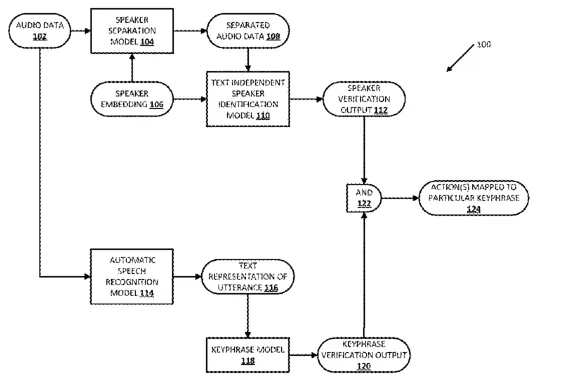
This patent describes a system that listens for specific voice commands while filtering out background noise and other people's voices. It uses a model to identify if the speaker is a registered user before executing the command, allowing for personalized voice shortcuts without retraining the software.
In the filing’s own words
Techniques disclosed herein are directed towards streaming keyphrase detection which can be customized to detect one or more particular keyphrases, without requiring retraining of any model(s) for those particular keyphrase(s). Many implementations include processing audio data using a speaker separation model to generate separated audio data which isolates an utterance spoken by a human speaker from one or more additional sounds not spoken by the human speaker, and processing the separated audio data using a text independent speaker identification model to determine whether a verified and/or registered user spoke a spoken utterance captured in the audio data. Various implementations include processing the audio data and/or the separated audio data using an automatic speech recognition model to generate a text representation of the utterance. Additionally or alternatively, the text representation of the utterance can be processed to determine whether at least a portion of the text representation of the utterance captures a particular keyphrase. When the system determines the registered and/or verified user spoke the utterance and the system determines the text representation of the utterance captures the particular keyphrase, the system can cause a computing device to perform one or more actions corresponding to the particular keyphrase.
What exactly they claim (claim 1)
1. A method implemented by one or more processors, the method comprising: identifying a plurality of device speaker embeddings, each device speaker embedding of the plurality of device speaker embeddings corresponding to a distinct user included in a group of multiple users; processing the plurality of device speaker embeddings to generate a multi-user speaker embedding that corresponds to the group of multiple users; receiving audio data that captures an utterance of a given user, included in the group of multiple users, and that also captures one or more additional sounds that are not from the group of multiple users; processing the audio data and the multi-user speaker embedding, using a multi-user voice filter model, to generate separated audio data which separates the utterance of the given user from the one or more additional sounds that are not from the group of multiple users; processing the separated audio data using an automatic speech recognition (“ASR”) model to generate a text representation of the utterance; and in response to generating the separated audio data and generating the text representation: causing a client device to perform one or more actions that are based on the text representation.
Facts
- Company
- Google (GOOGLE LLC)
- Official title
- Voice shortcut detection with speaker verification
- Patent number
- US12776323B2
- Application number
- 18765108
- Filed
- Jul 5, 2024
- Granted
- Oct 27, 2026
- Inventors
- 5
- Claims
- 20
Classified under
G10L 17/24 Physics & computingG10L 15/26 Physics & computingG10L 17/06 Physics & computingG10L 21/028 Physics & computingMore from Google in Audio & voice
- Google patents voice assistant that cuts off its own answer to hear a new question Sep 15, 2026
- Google patents system to create sound effects from text descriptions Nov 3, 2026
- Google patents head-worn device that cleans up voice using bone vibration Sep 17, 2026
- Google patents voice assistant that asks before acting on commands Sep 1, 2026
- Google patents ring design to smooth out microphone sound quality Sep 1, 2026
Summaries are simplified from the filing’s own abstract and first claim. A patent filing is not a product announcement.
Patent data and drawings: U.S. Patent and Trademark Office (USPTO). Nebula is not affiliated with or endorsed by the USPTO.