Amazon patents method to hide personal info in images for AI training
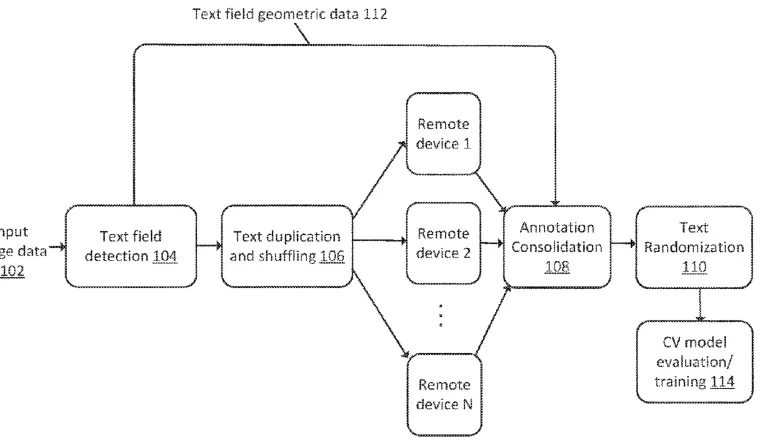
Amazon has patented a technique for training computer vision models while protecting privacy. The system splits images containing personal data into separate pieces, sends them to different annotators, and replaces the sensitive text with random characters before combining them.
In the filing’s own words
Devices and techniques are generally described for privacy preservation for computer vision models. In some examples, a first field of text and a second field of text may be detected in a first image. A first alpha-numeric text string may be detected in the first field and a second alpha-numeric text string may be detected in the second field. A first sub-image including the first alpha-numeric text string may be generated and a second sub-image including the second alpha-numeric text string may be generated. The first sub-image may be sent to a first computing device for annotation and the second sub-image may be sent to a second computing device for annotation.
What exactly they claim (claim 1)
1. A computer-implemented method comprising: generating, by fragmenting a first image, a first sub-image, wherein the first sub-image includes a first segment of personally-identifiable information (PII), wherein the first segment comprises a partially-complete portion of first PII in a first field from which the first segment of PII is determined; generating, by fragmenting the first image, a second sub-image, wherein the second sub-image includes a second segment of PII, wherein the first segment comprises a partially-complete portion of second PII in a second field from which the second segment is determined; determining a first alpha-numeric text string in the first field; determining a second alpha-numeric text string in the second field; receiving, from a first annotator, first label data for the first sub-image, based on the first alpha-numeric text string; receiving, from a second annotator, second label data for the second sub-image, based on the second alpha-numeric text string; generating, by combining the first sub-image and the second sub-image, second image data, wherein the second image data represents a background of the first image with the first alpha-numeric text string removed from the first field and the second alpha-numeric text string removed from the second field; and generating modified second image data by populating the first field in the second image data with a first randomized alpha-numeric text string and the second field in the second image data with a second randomized alpha-numeric text string.
Facts
- Company
- Amazon (Amazon Technologies, Inc.)
- Official title
- Privacy-preserving training and evaluation of computer vision models
- Patent number
- US12802479B2
- Application number
- 18214108
- Filed
- Jun 26, 2023
- Granted
- Nov 17, 2026
- Inventors
- 2
- Claims
- 18
Classified under
G06V 30/19147 Physics & computingG06V 20/62 Physics & computingG06V 20/70 Physics & computingG06V 30/1448 Physics & computingG06V 30/15 Physics & computingG06V 30/30 Physics & computingMore from Amazon in Security & privacy
- Amazon patents camera encryption that cuts cloud access Sep 8, 2026
- Amazon patents voice assistant login using a second device Sep 1, 2026
- Amazon patents system to spot suspicious IP activity in its network Sep 8, 2026
- Amazon patents radar system that triggers cameras only on real motion Sep 15, 2026
- Amazon patents ad system that groups anonymous users without cookies Sep 22, 2026
Summaries are simplified from the filing’s own abstract and first claim. A patent filing is not a product announcement.
Patent data and drawings: U.S. Patent and Trademark Office (USPTO). Nebula is not affiliated with or endorsed by the USPTO.