Nvidia patents method to clean up reflections in 3D graphics
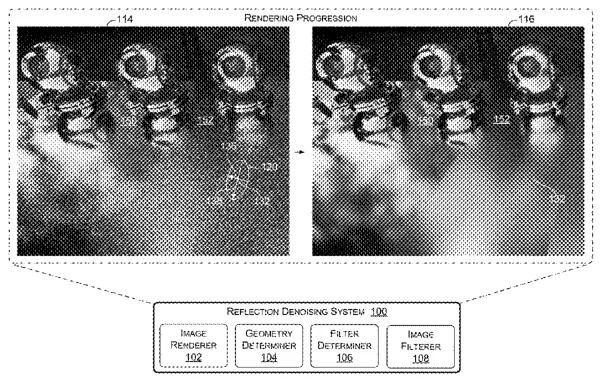
Nvidia describes a technique for making reflections in computer-generated images look smoother and more realistic. The system analyzes how light bounces off virtual surfaces to create a specific filter that removes visual noise, or graininess, from the reflection.
In the filing’s own words
Disclosed approaches may leverage the actual spatial and reflective properties of a virtual environment—such as the size, shape, and orientation of a bidirectional reflectance distribution function (BRDF) lobe of a light path and its position relative to a reflection surface, a virtual screen, and a virtual camera—to produce, for a pixel, an anisotropic kernel filter having dimensions and weights that accurately reflect the spatial characteristics of the virtual environment as well as the reflective properties of the surface. In order to accomplish this, geometry may be computed that corresponds to a projection of a reflection of the BRDF lobe below the surface along a view vector to the pixel. Using this approach, the dimensions of the anisotropic filter kernel may correspond to the BRDF lobe to accurately reflect the spatial characteristics of the virtual environment as well as the reflective properties of the surface.
What exactly they claim (claim 1)
1. A system comprising: one or more processors for executing instructions stored in memory to perform operations including: determining one or more reflective values representative of a reflective property for a surface based at least on a point that corresponds to the surface in a virtual environment; selecting at least one specular model from a plurality of specular models based at least on the one or more reflective values exceeding one or more threshold values; based at least on the selecting, using the at least one specular model to determine lighting condition data for the point; and rendering one or more images corresponding to the virtual environment using the lighting condition data.
Facts
- Company
- Nvidia (NVIDIA Corporation)
- Official title
- Reflection denoising in ray-tracing applications
- Patent number
- US12802333B2
- Application number
- 18612293
- Filed
- Mar 21, 2024
- Granted
- Nov 17, 2026
- Inventors
- 5
- Claims
- 20
Classified under
G06T 15/06 Physics & computingG06T 5/20 Physics & computingG06T 5/70 Physics & computingG06T 15/506 Physics & computingG06T 15/60 Physics & computingG06T 2210/21 Physics & computingMore from Nvidia in Chips & hardware
- Nvidia stacks memory directly on chips to boost data speed Nov 10, 2026
- Nvidia patents method to skip zero data in neural network math Oct 13, 2026
- Nvidia patents hardware to speed up motion blur in ray tracing Oct 13, 2026
- Nvidia patents method to sync data across split processor chips Sep 17, 2026
- Nvidia patents chip math trick to speed up AI calculations Oct 8, 2026
Summaries are simplified from the filing’s own abstract and first claim. A patent filing is not a product announcement.
Patent data and drawings: U.S. Patent and Trademark Office (USPTO). Nebula is not affiliated with or endorsed by the USPTO.