Waymo patents radar self-check using weak signal echoes
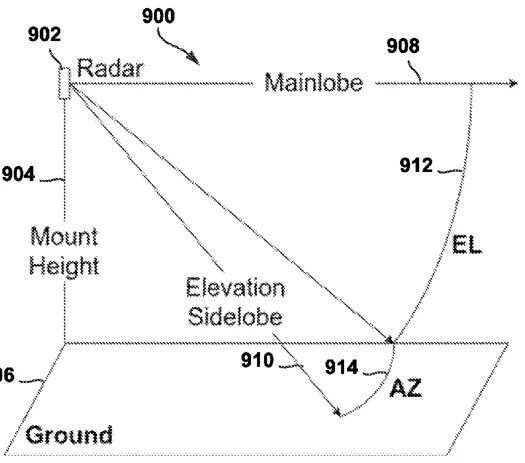
This patent describes a method for self-calibrating a car's radar sensor by analyzing weak, unintended signal echoes called sidelobes. The system compares the current position of these echoes to a stored baseline to detect if the radar is tilted, then adjusts its settings to maintain accuracy.
In the filing’s own words
Example embodiments relate to techniques and systems for using elevation sidelobe measurements to validate automotive radar pitch. A vehicle computing system can cause a radar to transmit radar signals into an environment of the vehicle and receive radar data corresponding to the transmitted radar signals. The computing system identifies a sidelobe represented in the radar data and estimates a relative measurement corresponding to the sidelobe. The relative measurement corresponding to the sidelobe represents at least an elevation measurement or an azimuth measurement corresponding to the sidelobe. The computing system then determines a pitch error based on a comparison between the relative measurement corresponding to the sidelobe and a reference sidelobe measurement and performs a calibration process for subsequent operation of the radar based on the pitch error. A computing system can also use elevation sidelobe measurements to estimate vehicle speed, detect road grade changes, and detect precipitation on the road.
What exactly they claim (claim 1)
1. A method comprising: causing, by a computing system coupled to a vehicle, a radar to transmit radar signals into an environment of the vehicle, wherein a radiation pattern of the radar includes a main lobe and an elevation sidelobe; receiving, at the computing system, radar data corresponding to the transmitted radar signals; identifying the elevation sidelobe represented in the radar data based on a signal strength of the elevation sidelobe being below a signal strength of the main lobe and above a noise floor; estimating a relative measurement corresponding to the elevation sidelobe, wherein the relative measurement corresponding to the elevation sidelobe represents an elevation measurement corresponding to the elevation sidelobe; determining a pitch error based on a comparison between the relative measurement corresponding to the elevation sidelobe and a reference sidelobe measurement, wherein the reference sidelobe measurement comprises an initial elevation measurement of the elevation sidelobe stored in a memory, and wherein the pitch error represents a change in pitch of the radar based on a difference between the elevation measurement corresponding to the elevation sidelobe and the initial elevation measurement; and based on the pitch error, performing a calibration process for subsequent operation of the radar.
Facts
- Company
- Google (Waymo LLC)
- Official title
- Methods and systems for validating automotive radar pitch using elevation sidelobe measurements
- Patent number
- US12800715B2
- Application number
- 18522666
- Filed
- Nov 29, 2023
- Granted
- Nov 17, 2026
- Inventors
- 1
- Claims
- 20
Classified under
G01S 7/4039 Physics & computingG01S 13/60 Physics & computingMore from Google in Cars & transport
- Waymo patents system to detect cyclists losing control before they fall Sep 8, 2026
- Waymo patents self-driving cars that hear sirens and pull over Sep 8, 2026
- Waymo patents AI that moves self-driving cars out of traffic jams Sep 29, 2026
- Waymo patents driverless cars with just two buttons for passengers Nov 3, 2026
- Waymo patents AI that predicts driving scenes from sensor data Oct 1, 2026
Summaries are simplified from the filing’s own abstract and first claim. A patent filing is not a product announcement.
Patent data and drawings: U.S. Patent and Trademark Office (USPTO). Nebula is not affiliated with or endorsed by the USPTO.