Amazon patents robot logic to find the best spot to see objects
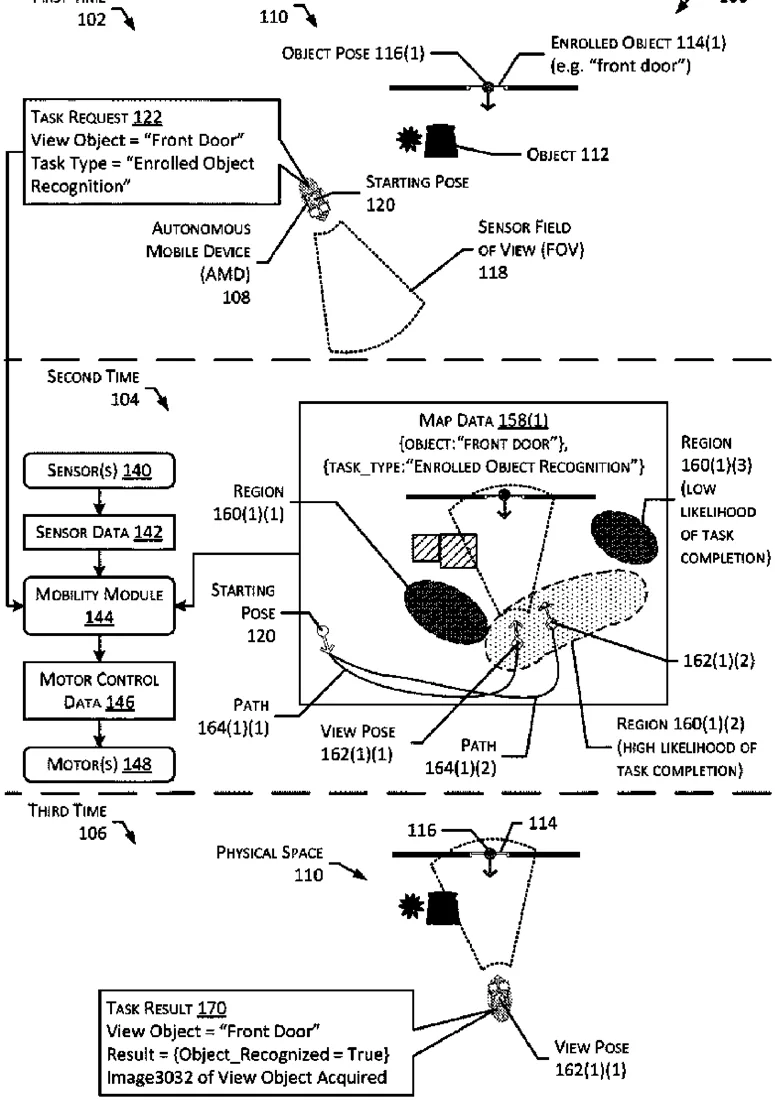
This patent describes a method for autonomous mobile devices, like warehouse robots, to determine the best location and angle to view a specific object. The system uses a map of the environment that marks areas where the object is visible or hidden, allowing the robot to move to a spot with a high likelihood of successfully completing a visual task.
In the filing’s own words
An autonomous mobile device (AMD) moves within a physical space and performs object perception tasks, such as checking whether a door is open or closed, using sensor data acquired from a sensor having a field-of-view (FOV). To perform the task, an enrolled object must be visible within the FOV. A view pose indicates a location and orientation in the physical space that is expected to place the enrolled object within the FOV. A map is generated based on previously acquired sensor data, indicating one or more of visible or non-visible regions. A visible region encompasses poses for which the enrolled object was visible. A non-visible region encompasses poses for which the enrolled object was not visible. When an object perception task is requested for the enrolled object, a view pose within the visible region is determined. The AMD may then move to the view pose and acquire sensor data.
What exactly they claim (claim 1)
1. An autonomous mobile device (AMD) comprising: a first sensor having a first field-of-view (FOV); one or more motors; one or more processors; and one or more computer readable media storing processor executable instructions which, when executed using the one or more processors, cause the AMD to: store first region data indicating a first region for a first map, wherein the first region is associated with: a first portion of a physical space, a first object, a first task type that utilizes sensor data of the first object, and a first metric that is indicative of a likelihood of successful completion of the first task type by the AMD within the first region; determine a first task, wherein the first task is associated with the first object and the first task type; determine that the first metric associated with the first task type is greater than a threshold value; responsive to determining that the first metric associated with the first task type is greater than the threshold value, determine, based on the first task and the first map, that moving the AMD to within the first region will allow for successful completion of the first task; determine a first location within the first region that will allow for successful completion of the first task; determine a first orientation for the first sensor at the first location that will allow for successful completion of the first task; move, using the one or more motors: the AMD to the first location, and the first sensor to the first orientation; and acquire first sensor data using the first sensor at the first location and the first orientation as part of performing the first task.
Facts
- Company
- Amazon (AMAZON TECHNOLOGIES, INC.)
- Official title
- System to determine pose of an autonomous mobile device for perception tasks
- Patent number
- US12792048B1
- Application number
- 18614397
- Filed
- Mar 22, 2024
- Granted
- Nov 10, 2026
- Inventors
- 2
- Claims
- 20
Classified under
G05D 1/2462 Physics & computingG05D 1/6484 Physics & computingG06Q 30/0283 Physics & computingG05D 2107/40 Physics & computingMore from Amazon in Robots & automation
- Amazon patents robot coordination using machine learning Nov 10, 2026
- Amazon patents software that designs custom robots for specific tasks Sep 8, 2026
- Amazon patents robots that move items to custom box makers Sep 8, 2026
- Amazon patents robots to move boxes between warehouse floors Sep 8, 2026
- Amazon patents robot arm that adjusts grip if objects swing Sep 15, 2026
Summaries are simplified from the filing’s own abstract and first claim. A patent filing is not a product announcement.
Patent data and drawings: U.S. Patent and Trademark Office (USPTO). Nebula is not affiliated with or endorsed by the USPTO.