Nvidia patents AI system that animates human characters from text prompts
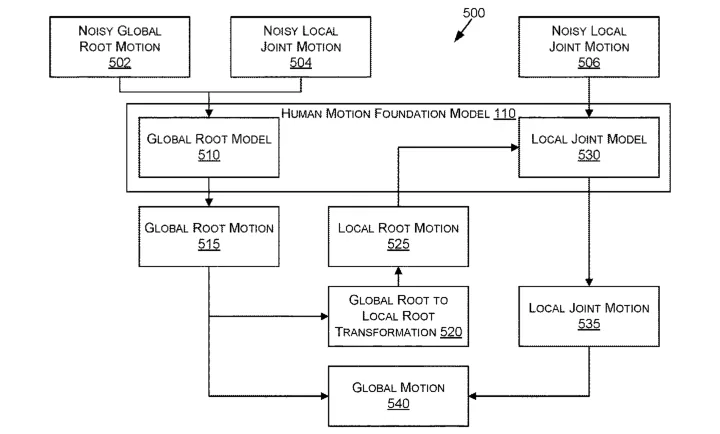
Nvidia describes a system that uses machine learning to create realistic movement for digital human characters. It takes a text description or specific movement rules and uses a two-part model to generate the character's overall body position and the detailed movement of their joints.
In the filing’s own words
Systems and methods are disclosed relating to receiving at least one of a text prompt or a kinematic constraint, generating, by a motion model including a first model and a second model, human motion data of a human character by applying a random noise and the at least one of the text prompt or the kinematic constraint into the motion model. Generating the human motion data includes, for each iteration of diffusion determining, using the first model, global root motion by applying noisy global root motion and noisy local joint motion as inputs into the first model and determining, using the second model, local joint motion by applying the noisy local joint motion and local root motion as inputs into the second model. The local root motion is determined based on the global root motion. The human motion data includes the local joint motion and the global root motion.
What exactly they claim (claim 1)
1. A system comprising one or more processors to: receive at least one of a text prompt or a kinematic constraint; generate, by a motion model comprising a first model and a second model, human motion data of a human character by applying a random noise and the at least one of the text prompt or the kinematic constraint into the motion model, generating the human motion data comprises, for each iteration of one or more interleaved diffusion iterations: determining, using the first model in each iteration of the one or more interleaved diffusion iterations, global root motion by denoising noisy global root motion and noisy local joint motion applied as inputs into the first model in a first denoising step; determining the local root motion based at least on the global root motion; and determining, using the second model in each iteration of the interleaved diffusion, local joint motion by applying the noisy local joint motion and local root motion as inputs into the second model and denoising the noisy local joint motion based at least on the local root motion in a second denoising step, the human motion data comprising the local joint motion and the global root motion.
Facts
- Company
- Nvidia (NVIDIA Corporation)
- Official title
- Machine learning models for generative human motion simulation
- Patent number
- US12784317B2
- Application number
- 18413967
- Filed
- Jan 16, 2024
- Granted
- Nov 3, 2026
- Inventors
- 10
- Claims
- 20
Classified under
G06T 13/40 Physics & computingG06F 40/40 Physics & computingG06T 7/20 Physics & computingMore from Nvidia in AI & software
- Nvidia patents AI coach that analyzes your gameplay to suggest strategies Oct 13, 2026
- Nvidia patents AI system that writes and voices character conversations Sep 10, 2026
- Nvidia patents system that uses AI to find bugs in game videos Sep 17, 2026
- Nvidia patents chip that turns text into video using noise reduction Nov 5, 2026
- Nvidia patents system that translates specific speakers in group conversations Nov 12, 2026
Summaries are simplified from the filing’s own abstract and first claim. A patent filing is not a product announcement.
Patent data and drawings: U.S. Patent and Trademark Office (USPTO). Nebula is not affiliated with or endorsed by the USPTO.