Samsung patents HMD that shows hidden body parts from another headset
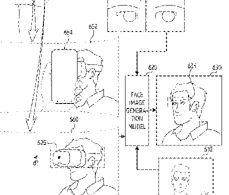
Samsung describes a head-mounted display that uses a camera to see the outside world and detects when another user is wearing a similar device. It receives data from that other device to create a digital image of the body part hidden by the headset, then places this image into the live camera feed so the wearer can see the other person's face or hands.
In the filing’s own words
A processor of a head-mounted display (HMD) device according to an embodiment controls a camera to obtain a first image of the outside of the HMD device. The processor detects a portion of the first image corresponding to an external HMD device. The processor receives information with respect to a body part covered by the external HMD device from the external HMD device through a communication circuit. The processor obtains a second image representing the body part by performing rendering on the body part based on the information. The processor displays the second image positioned in the portion of the first image and a composite image including the first image through at least one display.
What exactly they claim (claim 1)
1. A head-mounted display (HMD) device, comprising: a camera; a communication circuit; at least one display; memory storing one or more computer programs; and one or more processors communicatively coupled to the camera, the communication circuit, the at least one display, and the memory, wherein the one or more computer programs include computer-executable instructions that, when executed by the one or more processors individually or collectively, cause the HMD device to: control the camera to obtain a first image outside of the HMD device, detect a portion of the first image corresponding to an external HMD device, receive, from the external HMD device through the communication circuit, information with respect to a body part covered by the external HMD device, obtain, by performing a rendering with respect to the body part based on the information, a second image representing the body part, and display, via the at least one display, a composite image including the first image and the second image, wherein the second image is positioned at the portion of the first image.
Facts
- Company
- Samsung (Samsung Electronics Co., Ltd.)
- Official title
- Electronic device for synthesizing image obtained from camera and method thereof
- Patent number
- US12784306B2
- Application number
- 18781119
- Filed
- Jul 23, 2024
- Granted
- Nov 3, 2026
- Inventors
- 7
- Claims
- 20
Classified under
G06T 19/20 Physics & computingG06F 3/013 Physics & computingG06T 7/70 Physics & computingG06T 17/20 Physics & computingH04N 23/61 Electricity & electronicsG06T 2207/20084 Physics & computingMore from Samsung in AR, VR & displays
- Samsung patents AR glasses that hide real-world objects on demand Nov 3, 2026
- Samsung patents eye-tracking to align video in AR glasses Oct 29, 2026
- Samsung patents screen that predicts where your eyes will look next Sep 29, 2026
- Samsung patents VR system that overlays real-world objects based on user actions Oct 27, 2026
- Samsung patents AR glasses that dim bright spots to prevent glare Nov 3, 2026
Summaries are simplified from the filing’s own abstract and first claim. A patent filing is not a product announcement.
Patent data and drawings: U.S. Patent and Trademark Office (USPTO). Nebula is not affiliated with or endorsed by the USPTO.