Samsung patents AR glasses that dim bright spots to prevent glare
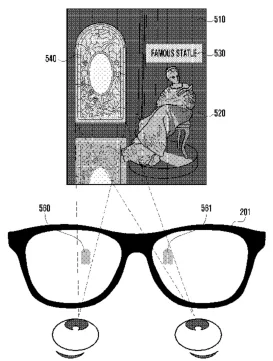
This filing describes AR glasses that use a camera and light sensor to detect when a bright object is causing glare in the user's view. The device then adjusts the transparency of the lens in that specific area to reduce the brightness, making the virtual content easier to see.
In the filing’s own words
An electronic device is provided. The electronic device is configured to acquire a captured image from a camera of the electronic device, identify a total quantity of light in an external environment through an illuminance sensor, recognize objects included in the captured image, determine a quantity of light for each of the recognized objects based on the overall total quantity of light in the captured image and color information of the captured image acquired through the camera, recognize a target object corresponding to a user gaze direction among objects included in the acquired captured image, output, through a transparent member and a display, a first AR service image including at least one virtual object of which at least a portion overlaps the image in associated with the recognized target object, and display, through the display, a second AR service image having the a reduced transmittance in at least a partial area of a transparent member corresponding to the a first object at locations of both eyes of the user, when a first object recognized as being in a glare state, exceeding a reference value, is present among objects located at a preset distance from the target object and/or the virtual object by comparing the quantity of light of the target object, the virtual object, and the objects recognized in the image.
What exactly they claim (claim 1)
1. An electronic device comprising: a frame; a transparent member configured to be supported by the frame; a display configured to output visual information to the transparent member; a camera provided to the frame; an illuminance sensor; memory, comprising one or more storage media, storing instructions; and one or more processors communicatively coupled to the memory, the display, the camera, and the illuminance sensor, wherein the instructions, when executed by the one or more processors individually or collectively, cause the electronic device to: acquire a captured image from the camera, identify a total quantity of light in an external environment through the illuminance sensor, recognize objects included in the captured image, determine a quantity of light for each of the recognized objects based on the total quantity of light in the captured image and color information of the captured image acquired through the camera, recognize a target object corresponding to a user gaze direction among objects included in the acquired captured image, output, through the transparent member and the display, a first augmented reality (AR) service image that includes at least one virtual object of which at least a portion overlaps the captured image in association with the recognized target object, and display, through the display, a second AR service image having a reduced transmittance in at least a partial area of a transparent member corresponding to a first object at locations of both eyes of the user, when the first object is recognized as being in a glare state, exceeding a reference value, is present among objects located at a preset distance from the target object and/or the virtual object by comparing the quantity of light of the target object, the virtual object, and the objects recognized in the image.
Facts
- Company
- Samsung (Samsung Electronics Co., Ltd.)
- Official title
- AR device and method for preventing glare in AR service image
- Patent number
- US12782741B2
- Application number
- 19357555
- Filed
- Oct 14, 2025
- Granted
- Nov 3, 2026
- Inventors
- 5
- Claims
- 19
Classified under
G02B 27/0172 Physics & computingG06F 3/013 Physics & computingG06V 10/26 Physics & computingG06V 10/60 Physics & computingG06V 10/945 Physics & computingG06V 10/993 Physics & computingMore from Samsung in AR, VR & displays
- Samsung patents AR glasses that hide real-world objects on demand Nov 3, 2026
- Samsung patents eye-tracking to align video in AR glasses Oct 29, 2026
- Samsung patents screen that predicts where your eyes will look next Sep 29, 2026
- Samsung patents VR system that overlays real-world objects based on user actions Oct 27, 2026
- Samsung patents HMD that shows hidden body parts from another headset Nov 3, 2026
Summaries are simplified from the filing’s own abstract and first claim. A patent filing is not a product announcement.
Patent data and drawings: U.S. Patent and Trademark Office (USPTO). Nebula is not affiliated with or endorsed by the USPTO.