Sony patents AI that plays video games in your style
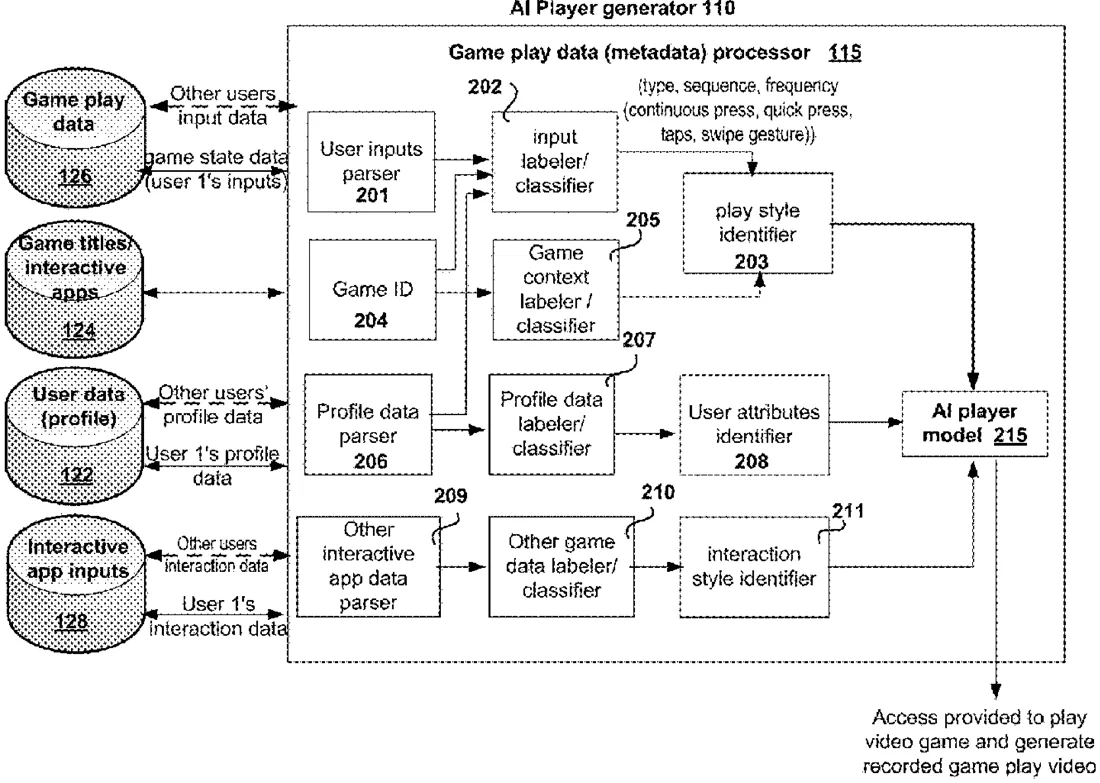
Sony describes a system that creates an AI player trained on your specific gaming inputs to mimic your play style. The AI can take over gameplay from where you left off, allowing you to watch the recording or jump back in control at any time.
In the filing’s own words
Methods and systems for engaging an AI player of a user to play a video game on behalf of the user includes creating the AI player for the user using at least some of the attributes of the user, training the AI player using inputs provided by the user during game play of the video game, and providing access to the video game for game play to the AI player. The access allows the AI player to provide inputs to the video game that substantially mimics a play style of the user. Control of the game play of the video game can be transitioned to the user at any time during the game play of the AI player. The user can also control the game play of the AI player from a video recording of the game play.
What exactly they claim (claim 1)
1. A method comprising: accessing first game play data comprising a plurality of first video frames, wherein the first game play data is generated based on one or more first game states generated based on first input data received from a client device associated with a user, and wherein the first input data represents first inputs provided by the user to the client device during a progression of a video game from a starting point in a video game to a first progress point in the video game; transferring the first game play data to the client device; creating an artificial intelligence (AI) player using first training data generated by identifying, based in-part on the first input data, a first play style exhibited by the user from the starting point in the video game to the first progress point in the video game, wherein the AI player is configured to mimic the first play style exhibited by the user; accessing second game play data comprising a plurality of second video frames, the plurality of second video frames occurring in a sequence of video frames after the plurality of first video frames, wherein the second game play data is generated based on one or more second game states generated based on second input data received from the client device, and wherein the second input data represents second inputs provided by the user to the client device during the progression of the video game from the first progress point in the video game to a second progress point in the video game that occurs after the first progress point; transferring the second game play data to the client device; training the AI player to result in a trained AI player using second training data generated by identifying, based in-part on the second input data, a second play style exhibited by the user from the first progress point to the second progress point in the video game, wherein the trained AI player is configured to mimic the second play style exhibited by the user; using the trained AI player to generate third game play data comprising a plurality of third video frames, the plurality of third video frames occurring in the sequence of video frames after the plurality of second video frames, wherein the third game play data is generated based on one or more third game states generated based on third input data, and wherein the third input data represents third inputs generated by the trained AI player during the progression of the video game from the second progress point to a third progress point in the video game, wherein the third progress point occurs after the second progress point in the video game; transferring the third game play data to the client device; extrapolating a plurality of fourth video frames from two or more third video frames of the plurality of third video frames, the plurality of fourth video frames depicting a character that mimics the second play style exhibited by the user and played by the trained AI player; and generating a video recording of the trained AI player progressing in the video game based on the third game play data and the plurality of fourth video frames.
Facts
- Company
- Sony (Sony Interactive Entertainment Inc.)
- Official title
- AI player model gameplay training and highlight review
- Patent number
- US12752193B2
- Application number
- 17948047
- Filed
- Sep 19, 2022
- Granted
- Oct 6, 2026
- Inventors
- 3
- Claims
- 21
Classified under
A63F 13/67 Human necessitiesA63F 13/355 Human necessitiesA63F 13/493 Human necessitiesA63F 13/497 Human necessitiesA63F 13/798 Human necessitiesG06N 20/00 Physics & computingMore from Sony in AI & software
- Sony patents AI that swaps game visuals for accessibility formats Sep 17, 2026
- Sony patents AI that changes game characters based on your play Oct 1, 2026
- Sony patents method to turn 2D videos into high-detail 3D animations Oct 15, 2026
- Sony patents AI bots that mimic your friends' gaming styles Sep 8, 2026
- Sony patents eye-tracking controls that link eye shapes to computer actions Sep 8, 2026
Summaries are simplified from the filing’s own abstract and first claim. A patent filing is not a product announcement.
Patent data and drawings: U.S. Patent and Trademark Office (USPTO). Nebula is not affiliated with or endorsed by the USPTO.