Meta patents glasses that build custom menus based on what you ask for

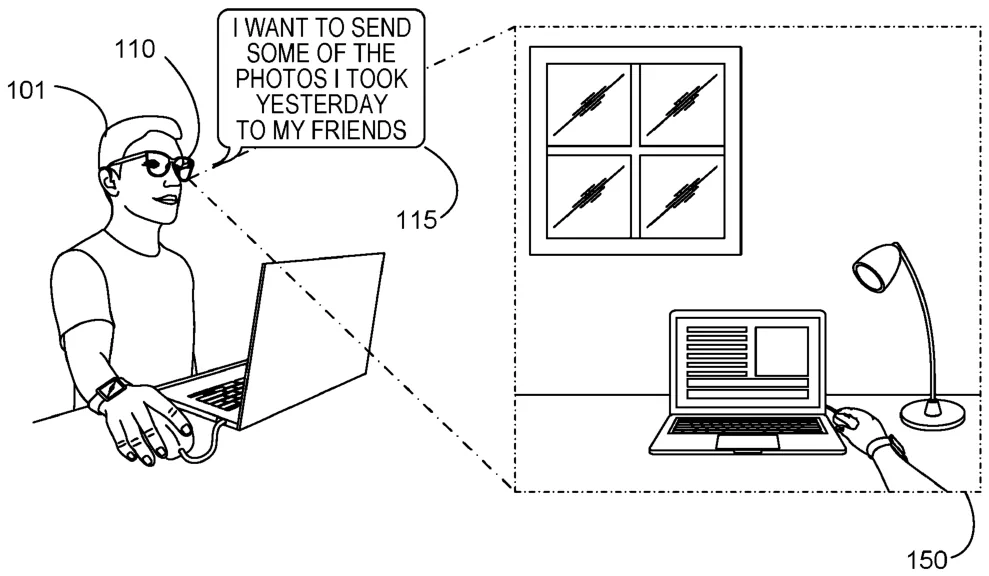
Meta describes a system for head-wearable devices that creates temporary user interface elements when a user requests a task that standard menus cannot handle. The system uses a machine-learning algorithm to generate these specific controls and displays them on the device's screens. Users can then interact with these generated elements using hand movements to complete the desired action.
In the filing’s own words
A method of interacting for presenting ad hoc user interfaces (UIs) to a user of a head-wearable device is described. The method includes, in response to a request, from the user, to perform tasks, causing UI elements to be generated. The UI elements is associated with a default display position. The method further includes, in accordance with a determination that a hand of the user is within a field-of-view of the user, determining a hand location of the hand of the user, wherein the hand location is distinct from the default display position. The method further includes causing displays of the head-wearable device to present the UI elements at the hand location. The method further includes, in accordance with a determination that the user performs a hand movement with the hand, causing the tasks to be performed, based on the hand movement.
What exactly they claim (claim 1)
1. A non-transitory, computer-readable storage medium including executable instructions that, when executed by one or more processors, cause the one or more processors to: while a head-wearable device is worn by a user, the head-wearable device associated with a predefined set of user interface (UI) elements: in response to a request, from the user, to perform one or more tasks, determine whether the one or more tasks can be performed using the predefined set of UI elements; in accordance with a determination that the one or more tasks cannot be performed using the predefined set of UI elements, cause a machine-learning algorithm to generate one or more generated UI elements based on the request; cause the one or more generated UI elements to be presented to the user at one or more displays of the head-wearable device; and in response to one or more user inputs directed at the one or more generated UI elements, cause the one or more tasks to be performed.
Facts
- Company
- Meta (Meta Platforms Technologies, LLC)
- Official title
- AD HOC USER INTERFACES AND GENERATED USER INTERFACES BASED ON USER REQUESTS AND USER INTENT, AND TECHNIQUES AND SYSTEMS OF USE THEREOF
- Publication number
- US20260339498A1
- Application number
- 19649019
- Filed
- Apr 15, 2026
- Published
- Oct 29, 2026
- Inventors
- 5
- Claims
- 20
Classified under
G06F 3/04847 Physics & computingG06F 3/0482 Physics & computingG06F 3/167 Physics & computingMore from Meta in AR, VR & displays
- Meta patents VR avatars that mimic facial expressions from voice Sep 15, 2026
- Meta patents headset sensors that track facial muscle blood flow Nov 10, 2026
- Meta patents spatial mouse for pointing at and controlling real-world objects Sep 24, 2026
- Meta patents AR notifications that grow when you look at them Sep 1, 2026
- Meta patents AR glasses with antennas built into the lenses Sep 8, 2026
Summaries are simplified from the filing’s own abstract and first claim. A patent filing is not a product announcement.
Patent data and drawings: U.S. Patent and Trademark Office (USPTO). Nebula is not affiliated with or endorsed by the USPTO.