Apple patents phone feature to drop low-priority data when memory is full
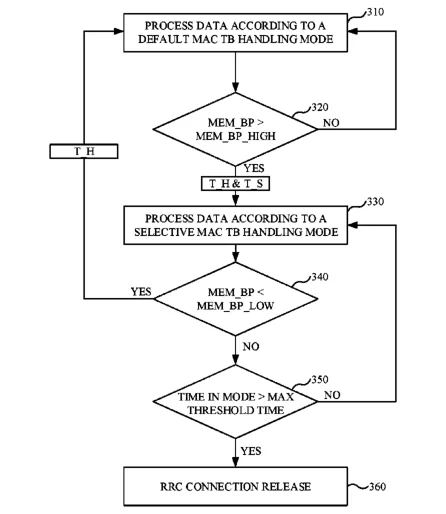
Apple describes a method where a phone's baseband processor monitors how full the main processor's memory is. If memory gets too crowded, the phone stops processing lower-priority data packets to free up space for critical network tasks.
In the filing’s own words
Techniques described herein include solutions for adaptively handling transport blocks (TBs) based on current memory backpressure conditions. In some aspects, a user equipment (UE) monitors a memory backpressure associated with an application processor of the UE. A baseband processor of the UE may receive a plurality of TBs (e.g., from a base station). Based on the memory backpressure, the UE may choose to only decode TBs having certain prioritized data types, and drop or ignore the remaining TBs. For example, the UE may drop certain low priority TBs destined for the application processor, which alleviates the memory backpressure by allowing the application processor to process piled up TBs causing the memory backpressure. In addition, this frees memory in the baseband processor, allowing the UE to handle high priority TBs used for essential functions (e.g., connection and synchronization with the network) in high memory backpressure scenarios.
What exactly they claim (claim 1)
1. A baseband processor comprising: one or more processors configured to execute instructions stored in a memory to: monitor a memory backpressure associated with an application processor; in response to the memory backpressure exceeding a first selective handling threshold, enter a selective medium access control (MAC) transport block (TB) handling mode, in which MAC TBs are handled based on a priority rule; and perform a radio resource control (RRC) connection release procedure in response to remaining in the selective MAC TB handling mode for greater than a maximum threshold time.
Facts
- Company
- Apple (Apple Inc.)
- Official title
- Smart MAC downlink transport block handling
- Patent number
- US12804452B2
- Application number
- 18304486
- Filed
- Apr 21, 2023
- Granted
- Nov 17, 2026
- Inventors
- 4
- Claims
- 20
Classified under
H04W 28/0252 Electricity & electronicsH04W 28/0278 Electricity & electronicsH04W 28/06 Electricity & electronicsH04W 76/30 Electricity & electronicsH04W 76/34 Electricity & electronicsMore from Apple in Networks & wireless
- Apple patents interface for sending messages via satellite Sep 29, 2026
- Apple patents way for phones to switch from ground towers to satellites Sep 17, 2026
- Apple patents moving phone plans between devices via Bluetooth Sep 1, 2026
- Apple patents sharing Wi-Fi channel data to speed up device connections Sep 1, 2026
- Apple patents smart surface that helps phones find signal faster Sep 8, 2026
Summaries are simplified from the filing’s own abstract and first claim. A patent filing is not a product announcement.
Patent data and drawings: U.S. Patent and Trademark Office (USPTO). Nebula is not affiliated with or endorsed by the USPTO.