Google patents wireless system mixing AI and fixed math for signal processing
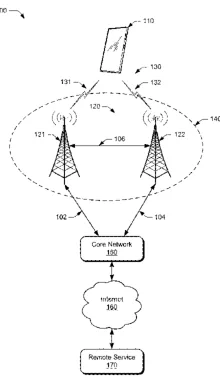
This patent describes a method for sending wireless data by combining deep neural networks with traditional, fixed mathematical algorithms. The system allows a base station to select specific AI settings that turn raw data into signals, while also using a technique called federated learning to update these AI models across multiple devices without sharing their private data.
In the filing’s own words
Techniques and apparatuses are described for hybrid wireless communications processing chains that include deep neural networks (DNNs) and static algorithm modules. In aspects, a first wireless communication device communicates with a second wireless device using a hybrid transmitter processing chain. The first wireless communication device selects a machine-learning configuration (ML configuration) that forms a modulation deep neural network (DNN) that generates a modulated signal using encoded bits as an input. The first wireless communication device forms, based on the modulation ML configuration, the modulation DNN as part of a hybrid transmitter processing chain that includes the modulation DNN and at least one static algorithm module. In response to forming the modulation DNN, the first wireless communication devices processes wireless communications associated with the second wireless communication device using the hybrid transmitter processing chain.
What exactly they claim (claim 1)
1. A method implemented by a base station for communicating, using a hybrid wireless communications processing chain, with a first user equipment (UE), the method comprising: selecting, using the base station, a base station-side (BS-side) modulation machine-learning (ML) configuration for forming a BS-side modulation deep neural network (DNN) that generates a modulated signal using encoded bits, received from an encoding module, as an input; forming, based on the BS-side modulation ML configuration, the BS-side modulation DNN as part of a hybrid transmitter processing chain that includes the BS-side modulation DNN and at least one static algorithm module; transmitting wireless communications associated with the first UE using the hybrid transmitter processing chain; receiving first UE-side ML configuration updates to a common ML configuration from the first UE, the common ML configuration being a demodulation ML configuration or a modulation ML configuration; receiving second UE-side ML configuration updates to the common ML configuration from a second UE; selecting an updated common ML configuration using federated learning techniques, the first UE-side ML configuration updates, and the second UE-side ML configuration updates; and directing the first UE and the second UE to update a respective UE-side DNN using the updated common ML configuration.
Facts
- Company
- Google (Google LLC)
- Official title
- Hybrid wireless processing chains that include deep neural networks and static algorithm modules
- Patent number
- US12804422B2
- Application number
- 18687226
- Filed
- Sep 12, 2022
- Granted
- Nov 17, 2026
- Inventors
- 2
- Claims
- 20
Classified under
H04W 24/02 Electricity & electronicsH04L 41/16 Electricity & electronicsMore from Google in Networks & wireless
- Google patents way for phones to send data without waking up fully Sep 8, 2026
- Google patents faster data handoff for phones in standby mode Sep 15, 2026
- Google patents video calls that change quality settings mid-conversation Sep 29, 2026
- Google patents video coding that trims extra detail to fit bandwidth limits Sep 29, 2026
- Google patents method for phones to sync with satellite signals Sep 29, 2026
Summaries are simplified from the filing’s own abstract and first claim. A patent filing is not a product announcement.
Patent data and drawings: U.S. Patent and Trademark Office (USPTO). Nebula is not affiliated with or endorsed by the USPTO.