Apple patents smooth switching between 3D photo views
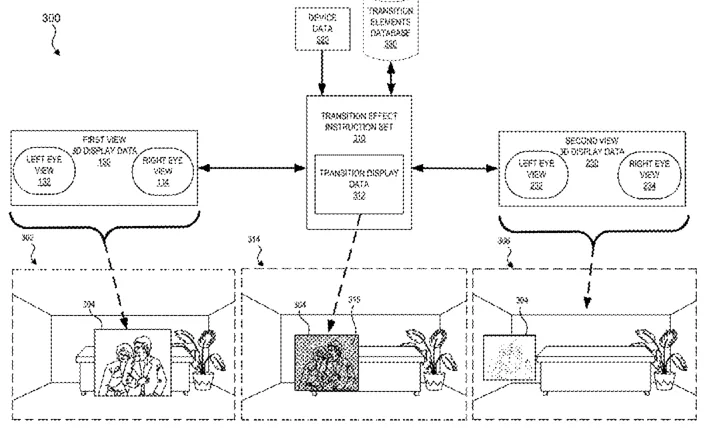
Apple has filed a patent for a method that switches how 3D photos and videos are displayed on a device. It moves from a view using separate left and right eye data to a shared 3D model when certain conditions are met, such as distance or depth quality changes. The system adds visual effects like blurring or animations to make this switch look smooth.
In the filing’s own words
Various implementations herein include devices, systems, and methods that determine and provide a transition (optionally including a transition effect) between different types of views of three-dimensional (3D) content. For example, an example process may include obtaining a 3D content item, providing a first view of the 3D content item within a 3D environment, determining to transition from the first view to a second view of the 3D content item based on a criterion, and providing the second view of the 3D content item within the 3D environment, where the left eye view and the right eye view of the 3D content item are based on at least one of the left eye content and the right eye content.
What exactly they claim (claim 1)
1. A method comprising: at an electronic device having a processor: obtaining a three-dimensional (3D) content item, the 3D content item comprising eye specific content comprising left eye content and right eye content generated based on camera images corresponding to left and right eye viewpoints; providing a first view of the 3D content item at a position within a 3D environment, wherein the first view comprises a left eye view of the 3D content item that is based on rendering the left eye content and a right eye view of the 3D content item that is based on rendering the right eye content; determining to transition from the first view that is based on rendering the eye-specific content to provide each of the left and right eye views to a second view of the 3D content item that is based on rendering a single shared point cloud representation to provide both of the left and right eye views, wherein determining to transition is based on a criterion, wherein the criterion is based on at least one of a change in quality of depth data, a gaze convergence angle threshold, and a distance threshold between the electronic device and the 3D content item; providing the second view of the 3D content item within the 3D environment, wherein the second view comprises the left eye view of the 3D content item that is based on the single shared point cloud representation and the right eye view of the 3D content item that is based on the single shared point cloud representation, wherein the single shared point cloud representation is derived from at least one of the left eye content and the right eye content; and providing a transition effect while transitioning from the first view to the second view, wherein the transition effect comprises at least one of a blurring effect, a halo effect, a curtain effect, or an animation effect.
Facts
- Company
- Apple (Apple Inc.)
- Official title
- Techniques for viewing 3D photos and 3D videos
- Patent number
- US12804117B2
- Application number
- 18367660
- Filed
- Sep 13, 2023
- Granted
- Nov 17, 2026
- Inventors
- 3
- Claims
- 22
Classified under
H04N 13/275 Electricity & electronicsG06T 17/00 Physics & computingH04N 13/344 Electricity & electronicsH04N 13/351 Electricity & electronicsH04N 13/383 Electricity & electronicsH04N 2013/0081 Electricity & electronicsMore from Apple in AR, VR & displays
- Apple patents AR glasses that zoom in on what you look at Sep 8, 2026
- Apple patents finger ring that controls VR with taps and waves Sep 15, 2026
- Apple patents head-mounted device that types via eye swipes and hand pinches Oct 6, 2026
- Apple patents eye-tracking and hand gestures to select screen items Oct 20, 2026
- Apple patents AR glasses that adjust lens spacing to fit your eyes Nov 3, 2026
Summaries are simplified from the filing’s own abstract and first claim. A patent filing is not a product announcement.
Patent data and drawings: U.S. Patent and Trademark Office (USPTO). Nebula is not affiliated with or endorsed by the USPTO.