Microsoft patents network fix that reroutes traffic before links fail
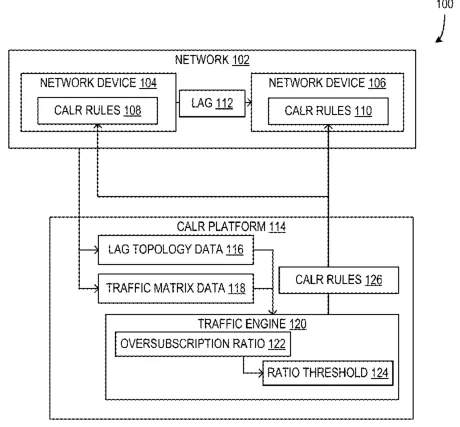
Microsoft describes a method for computer networks to automatically manage data flow by predicting when a connection is about to fail. The system simulates different traffic scenarios to calculate a specific bandwidth threshold, then shuts down the connection if it drops below that level to prevent data loss.
In the filing’s own words
A computerized method reduces contraction loss in a network using dynamically generated rules. Topology and traffic matrix data of a network are obtained, wherein the obtained data includes data associated with a network link of the network. A first traffic scenario is simulated to determine a down loss value of the network link, and a second traffic scenario is simulated to determine a contraction loss value of the network link. A capacity aware local repair (CALR) rule of the network link is generated using the determined down loss value and the determined contraction loss value, wherein the CALR rule includes a contracted bandwidth threshold. The generated CALR rule is provided to a network device associated with the network link, wherein the network device is enabled to set the network link to inactive based on bandwidth of the network link falling below the contracted bandwidth threshold of the generated CALR rule.
What exactly they claim (claim 1)
1. A system comprising: a processor; and a memory comprising computer program code, the memory and the computer program code configured to cause the processor to: obtain topology data associated with a network, wherein the network includes a network link and a network device associated with the network link; obtain traffic matrix data associated with the network, including traffic matrix data associated with the network link; simulate a first traffic scenario of the network where the network link is set to an inactive state using the obtained topology data and the obtained traffic matrix data; determine a down loss value of the network link using the simulated first traffic scenario; simulate a second traffic scenario of the network where the network link has a contracted bandwidth capacity using the obtained topology data and the obtained traffic matrix data; determine a contraction loss value of the network link using the simulated second traffic scenario; generate a capacity aware local repair (CALR) rule of the network link using the determined down loss value and the determined contraction loss value, wherein generating the CALR rule comprises calculating a contracted bandwidth threshold for the network link based on a requirement for performance of the network, the CALR rule including the contracted bandwidth threshold; determine that bandwidth of the network link has fallen below the contracted bandwidth threshold of the generated CALR rule; based on determining that the bandwidth has fallen below the contracted bandwidth threshold, cause the network link to be set to an inactive state; and based on the network link being set to the inactive state, cause traffic that would otherwise be routed to the network link to be rerouted to a backup network link.
Facts
- Company
- Microsoft (Microsoft Technology Licensing, LLC)
- Official title
- Reducing contraction loss in a network using dynamically generated rules
- Patent number
- US12803900B2
- Application number
- 18961431
- Filed
- Nov 26, 2024
- Granted
- Nov 17, 2026
- Inventors
- 3
- Claims
- 20
Classified under
H04L 45/28 Electricity & electronicsH04L 41/147 Electricity & electronicsH04L 45/02 Electricity & electronicsH04L 47/12 Electricity & electronicsH04L 45/245 Electricity & electronicsMore from Microsoft in Networks & wireless
- Microsoft patents camera-based data transfer between server displays Sep 22, 2026
- Microsoft patents system that uses AI to plan network capacity Oct 13, 2026
- Microsoft patents routers that handle AI data tasks directly Nov 3, 2026
- Microsoft patents method to spot cloud outages by checking individual user traffic Sep 10, 2026
- Microsoft patents hand gestures to control devices without menus Sep 24, 2026
Summaries are simplified from the filing’s own abstract and first claim. A patent filing is not a product announcement.
Patent data and drawings: U.S. Patent and Trademark Office (USPTO). Nebula is not affiliated with or endorsed by the USPTO.