Disney patents voice matching that works across different languages
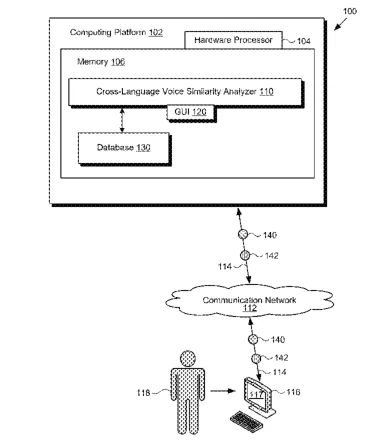
Disney has been granted a patent for a system that identifies a specific voice by breaking it down into basic sound components. The technology converts a voice sample into a mathematical format, reconstructs it, and compares it to a library of known voices to find a match, regardless of the language being spoken.
In the filing’s own words
A system includes a hardware processor and a memory storing a cross-language voice similarity analyzer (analyzer). The hardware processor executes the analyzer to generate an embedding vector representation of an audio sample of a human voice in a feature space including existing embedding vectors corresponding respectively to different reference voices, decompose the embedding vector representation to identify a linear or non-linear combination of vocal component vectors corresponding to the human voice, each vocal component vector representing a respective predetermined voice characteristic descriptor, increase the dimensionality of the linear or non-linear combination of the vocal component vectors to match the dimensionality of the embedding vector representation to provide a reconstructed embedding vector representation of the human voice, and identify, by comparing the reconstructed embedding vector representation with one or more of the existing embedding vectors, one of the reference voices as a match for the audio sample of the human voice.
What exactly they claim (claim 1)
1. A system comprising: a computing platform including a hardware processor; and a memory storing a cross-language voice similarity analyzer; the hardware processor configured to execute the cross-language voice similarity analyzer to: generate, using an audio sample of a human voice, an embedding vector representation of the human voice in a multi-dimensional feature space including a plurality of existing embedding vectors each corresponding respectively to a reference voice of a plurality of reference voices; decompose the embedding vector representation of the human voice, by reducing a dimensionality of the embedding vector representation of the human voice, to identify a linear combination of predetermined vocal component vectors corresponding to the human voice or a non-linear combination of predetermined vocal component vectors corresponding to the human voice, each of the predetermined vocal component vectors representing a respective one of a plurality of predetermined voice characteristic descriptors; increase a dimensionality of the linear combination of the predetermined vocal component vectors or the non-linear combination of the predetermined vocal component vectors to match a dimensionality of the embedding vector representation of the human voice to provide a reconstructed embedding vector representation of the human voice; and identify, by comparing the reconstructed embedding vector representation of the human voice with one or more of the plurality of existing embedding vectors, one of the plurality of reference voices as a match for the audio sample of the human voice.
Facts
- Company
- Disney (Disney Enterprises, Inc.)
- Official title
- Cross-language voice similarity analysis
- Patent number
- US12802712B2
- Application number
- 18817977
- Filed
- Aug 28, 2024
- Granted
- Nov 17, 2026
- Inventors
- 5
- Claims
- 20
Classified under
G10L 25/51 Physics & computingG10L 15/22 Physics & computingG10L 17/22 Physics & computingMore from Disney in Audio & voice
- Disney patents water harp that plays music when streams are broken Sep 8, 2026
- Disney patents tool to sync dubbed audio with original video Oct 20, 2026
- Disney patents video switch that changes sources without a glitch Nov 3, 2026
- Disney patents AI method to sync new audio with video timing Oct 8, 2026
Summaries are simplified from the filing’s own abstract and first claim. A patent filing is not a product announcement.
Patent data and drawings: U.S. Patent and Trademark Office (USPTO). Nebula is not affiliated with or endorsed by the USPTO.