Apple patents display tech that adjusts colors to match your room's lighting
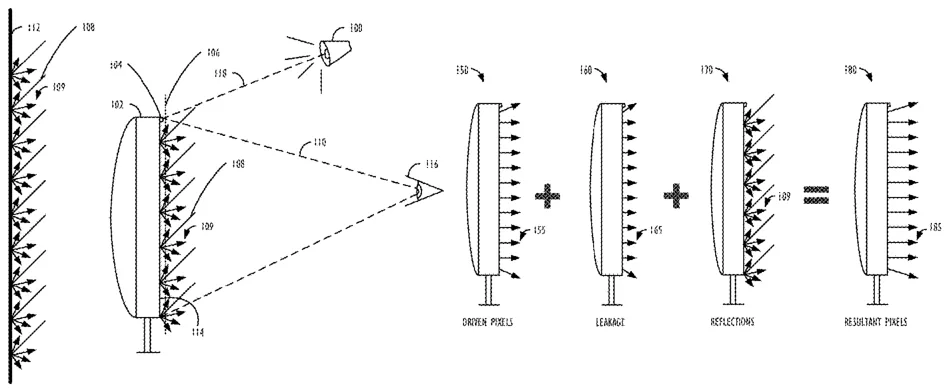
This patent describes a system that changes how images look on a screen to match the lighting in your room. It adjusts brightness, color, and contrast so the picture looks the same whether you are in a dark theater or a bright living room.
In the filing’s own words
Disclosed are dynamic system optical-to-optical transfer functions (OOTF), which adapt displayed content to provide a so-called “perceptual reference” effect for the viewer, wherein, as the current viewing conditions depart from a “reference” viewing scenario, the dynamic system OOTF adapts the content and/or display to provide the viewer with as close as possible to the perceptual effect of the “reference” viewing scenario. The dynamic system OOTF may perform one or more of the following adaptation processes: adapting media content from a source color space to a linear XYZ color space; adapting media content from a linear XYZ color space to a display device's color space; automatically adjusting display device brightness, white point, and/or black point; adapting media content from an intended viewing environment to a common compositing space's fixed viewing environment; and/or adapting media content from the common compositing space's fixed viewing environment to that of the viewer's current viewing conditions.
What exactly they claim (claim 1)
1. A method of displaying content on a display device, comprising: receiving data indicative of a first content item; linearizing the data indicative of the first content item according to an inverse transfer function associated with the first content item; mapping the linearized data indicative of the first content item from a first color space gamut associated with the first content item to a second color space gamut associated with a common compositing space; modifying the mapped, linearized data indicative of the first content item based on at least one of: (a) a first difference between a first intended viewing condition associated with the first content item and a second intended viewing condition associated with the common compositing space; and (b) a second difference between a first intended viewer adaptation level associated with the first content item and a first predicted viewer adaptation level; encoding the modified data indicative of the first content item according to a transfer function associated with the common compositing space; re-linearizing the encoded data indicative of the first content item according to an inverse transfer function associated with the common compositing space; mapping the re-linearized data indicative of the first content item from the second color space gamut associated with the common compositing space to a third color space gamut associated with the display device; applying a chromatic adaptation operation to the mapped, re-linearized data indicative of the first content item based on a measured white point of a current viewing condition around the display device; performing a simultaneous contrast adaptation on the first content item based on a third difference between the second intended viewing condition associated with the common compositing space and the current viewing condition around the display device; displaying the first content item on the display device; receiving data indicative of a second content item; linearizing the data indicative of the second content item according to an inverse transfer function associated with the second content item; mapping the linearized data indicative of the second content item from a fourth color space gamut associated with the second content item to the second color space gamut associated with a common compositing space; modifying the mapped, linearized data indicative of the second content item based on at least one of: (c) a fourth difference between a third intended viewing condition associated with the second content item and the second intended viewing condition associated with the common compositing space; and (d) a fifth difference between a second intended viewer adaptation level associated with the second content item and a second predicted viewer adaptation level; and encoding the modified data indicative of the second content item according to the transfer function associated with the common compositing space.
Facts
- Company
- Apple (Apple Inc.)
- Official title
- Dynamic system optical-to-optical transfer functions (OOTF) for providing a perceptual reference
- Patent number
- US12802662B2
- Application number
- 19113737
- Filed
- Sep 20, 2023
- Granted
- Nov 17, 2026
- Inventors
- 2
- Claims
- 14
Classified under
G09G 5/02 Physics & computingH04N 1/6066 Electricity & electronicsH04N 1/6088 Electricity & electronicsG09G 2320/0276 Physics & computingG09G 2320/066 Physics & computingG09G 2320/0666 Physics & computingMore from Apple in AR, VR & displays
- Apple patents AR glasses that zoom in on what you look at Sep 8, 2026
- Apple patents finger ring that controls VR with taps and waves Sep 15, 2026
- Apple patents head-mounted device that types via eye swipes and hand pinches Oct 6, 2026
- Apple patents eye-tracking and hand gestures to select screen items Oct 20, 2026
- Apple patents AR glasses that adjust lens spacing to fit your eyes Nov 3, 2026
Summaries are simplified from the filing’s own abstract and first claim. A patent filing is not a product announcement.
Patent data and drawings: U.S. Patent and Trademark Office (USPTO). Nebula is not affiliated with or endorsed by the USPTO.