Google patents method to spot network anomalies with less labeled data
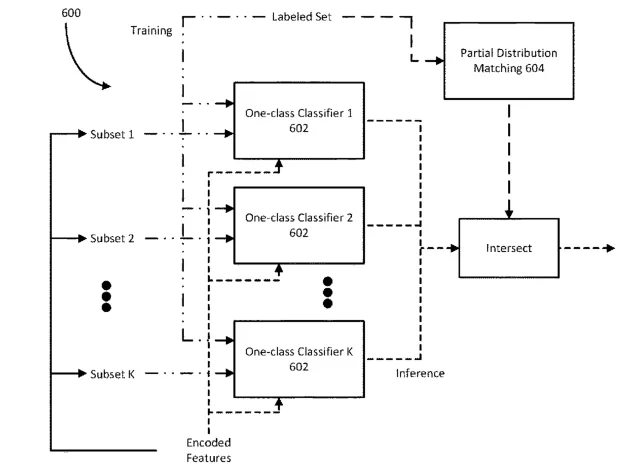
Google describes a system called SPADE that helps computers find unusual patterns in network traffic. It uses a group of simple detectors to guess which unlabeled data points are problems, allowing the main system to learn without needing a large set of pre-marked examples.
In the filing’s own words
Aspects of the disclosure are directed to a Semi-supervised Pseudo-labeler Anomaly Detection with Ensembling (SPADE) framework that is not limited by the assumption that labeled and unlabeled data come from the same distribution. SPADE utilizes an ensemble of one-class classifiers as the pseudo-labeler to improve the robustness of pseudo-labeling with distribution mismatch. Partial matching automatically selects critical hyper-parameters for pseudo-labeling without validation data, which is crucial with a limited amount of labeled data.
What exactly they claim (claim 1)
1. A method to train a binary classifier for anomaly detection, the method comprising: receiving, by one or more processors, unlabeled training data comprising data samples associated with anomaly detection; generating, by the one or more processors, pseudo labels for the unlabeled training data using a plurality of one-class classifiers, wherein a positive pseudo label is generated for a first unlabeled data sample of the unlabeled training data based on a threshold amount of the one-class classifiers indicating the first unlabeled data sample is anomalous and a negative pseudo label is generated for a second unlabeled data sample of the unlabeled training data based on the threshold amount of the one-class classifiers indicating the second unlabeled data sample is normal; assigning, by the one or more processors, the pseudo labels respectively to the data samples of the unlabeled training data to generate pseudo labeled training data; and training, by the one or more processors, the binary classifier to detect network anomalies based on minimizing a loss function that assigns a binary weight to each of the data samples of the pseudo labeled training data.
Facts
- Company
- Google (Google LLC)
- Official title
- Semi-supervised anomaly detection under distribution mismatch
- Patent number
- US12801846B2
- Application number
- 18150277
- Filed
- Jan 5, 2023
- Granted
- Nov 17, 2026
- Inventors
- 4
- Claims
- 20
Classified under
G06F 40/216 Physics & computingG06N 5/022 Physics & computingMore from Google in Security & privacy
- Google patents privacy score for third-party apps Sep 22, 2026
- Google patents meeting notes that hide names if you ask Nov 10, 2026
- Google patents phone feature to disable unknown trackers Oct 8, 2026
- Google patents on-device tool to flag misleading messages in real time Nov 5, 2026
- Google patents camera that deletes images before saving them Nov 5, 2026
Summaries are simplified from the filing’s own abstract and first claim. A patent filing is not a product announcement.
Patent data and drawings: U.S. Patent and Trademark Office (USPTO). Nebula is not affiliated with or endorsed by the USPTO.