Google patents private ad selection using split math
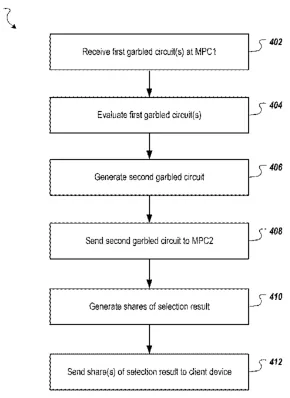
Google describes a method where two separate computers use cryptography to decide which ad to show a user without either computer seeing the full data. By splitting the decision into secret shares, the system ensures that neither party can see the user's specific data or the final choice alone.
In the filing’s own words
This document describes systems and techniques for using cryptography, secure MPC, garbled circuits, and oblivious transfer to select digital components in ways that preserve user privacy and protects the data of each party involved in the selection process. In one aspect, a method includes receiving, from a content platform by a first computer of a secure MPC system, a first garbled circuit for determining whether each of a first set of digital components satisfies a publication condition for display with a resource. The first computer evaluates the garbled circuit to obtain, for each digital component in the first set of digital components, a first secret share of a publication condition parameter that indicates whether the digital component satisfies the publication condition. The first computer generates a second garbled circuit for determining whether each digital component in a second set of digital components is eligible for display with the resource.
What exactly they claim (claim 1)
1. A computer-implemented method comprising: receiving, from a content platform and by a first computer of a secure multi-party computation (MPC) system comprising a plurality of computers, a first garbled circuit for determining whether each digital component of a first set of digital components satisfies a publication condition for display with a resource that is being displayed at a client device of a user, wherein the publication condition comprises a publisher-defined resource restriction rule evaluated against attributes of each digital component of the first set of digital components to determine whether each digital component of the first set of digital components is eligible for display at the client device of the user; evaluating, by the first computer, the first garbled circuit to obtain, for each digital component in the first set of digital components, a first secret share of a publication condition parameter that indicates whether the digital component in the first set of digital components satisfies the publication condition; generating, by the first computer, a second garbled circuit for determining whether each digital component in a second set of digital components is eligible for display with the resource, the second garbled circuit being generated subsequent to the evaluating of the first garbled circuit and based at least in part on incorporating (i) the first secret share of the publication condition parameter for each digital component in the first set of digital components as an input to the second garbled circuit and (ii) one or more additional eligibility conditions for each digital component in the second set of digital components; sending, by the first computer, the second garbled circuit to a second computer of the secure MPC system, wherein the second computer is configured to evaluate the second garbled circuit to obtain, for each digital component in the second set of digital components, a second secret share of an eligibility parameter that indicates whether the digital component in the second set of digital components is eligible for display with the resource, and wherein the first computer stores a first secret share of the eligibility parameter for each digital component in the second set of digital components; generating, in collaboration with the second computer and based at least in part on the first secret share of the eligibility parameter and the second secret share of the eligibility parameter for each digital component in the second set of digital components, secret shares of a selection result that indicates a selected digital component that is selected from a subset of the second set of digital components that are eligible for display with the resource; and sending, by the first computer, a first secret share of the selection result to the client device of the user.
Facts
- Company
- Google (Google LLC)
- Official title
- Efficient multiple garbled circuit protocol
- Patent number
- US12801794B2
- Application number
- 18857971
- Filed
- Jul 19, 2024
- Granted
- Nov 17, 2026
- Inventors
- 2
- Claims
- 20
Classified under
G06F 21/72 Physics & computingG06F 21/602 Physics & computingMore from Google in Security & privacy
- Google patents privacy score for third-party apps Sep 22, 2026
- Google patents meeting notes that hide names if you ask Nov 10, 2026
- Google patents phone feature to disable unknown trackers Oct 8, 2026
- Google patents on-device tool to flag misleading messages in real time Nov 5, 2026
- Google patents camera that deletes images before saving them Nov 5, 2026
Summaries are simplified from the filing’s own abstract and first claim. A patent filing is not a product announcement.
Patent data and drawings: U.S. Patent and Trademark Office (USPTO). Nebula is not affiliated with or endorsed by the USPTO.