Google patents chip trick to instantly erase encryption keys
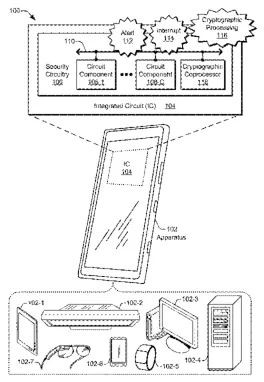
Google describes a secure chip design that protects encryption keys by scrambling them with a secret code. To delete sensitive data quickly, the chip changes this code, making the stored information unreadable, and then overwrites the code itself with random noise.
In the filing’s own words
An apparatus with an integrated circuit (IC) chip can provide protection against attacks on a cryptographic coprocessor. An attacker can compromise a cryptographic coprocessor by, for instance, obtaining a private encryption key or instruction code. To combat these attacks, example implementations store information in encrypted form. The information may correspond to data, instruction code, or intermediate values located in state registers. To securely and quickly “erase” such stored information, the cryptographic coprocessor can change the encryption key. In other example implementations, random numbers are provided with two different levels of “randomness quality” that is appropriate for different types of procedures. A cryptographic coprocessor can include two registers that store randomized bits in accordance with the two different quality levels for rapid access during cryptographic operations. To further thwart would-be attacks, a cryptographic coprocessor can verify the contents or usage of instruction code that is executed to perform cryptographic operations.
What exactly they claim (claim 1)
1. A method for a cryptographic coprocessor, the method comprising: obtaining, at the cryptographic coprocessor, digital information; scrambling, by the cryptographic coprocessor, the digital information using at least one scrambling key to produce scrambled digital information, the at least one scrambling key stored in at least one key register; storing, by the cryptographic coprocessor, the scrambled digital information in at least one memory; preventing, by the cryptographic coprocessor, access to the digital information by changing the at least one scrambling key, including overwriting the at least one key register with random bits; and performing, by the cryptographic coprocessor, a secure wipe by overwriting the random bits in the at least one key register with a constant value.
Facts
- Company
- Google (Google LLC)
- Official title
- Secure cryptographic coprocessor
- Patent number
- US12801793B2
- Application number
- 18554124
- Filed
- Apr 5, 2022
- Granted
- Nov 17, 2026
- Inventors
- 6
- Claims
- 19
Classified under
G06F 21/72 Physics & computingG06F 21/55 Physics & computingG06F 21/64 Physics & computingH04L 9/0869 Electricity & electronicsH04L 63/123 Electricity & electronicsG06F 2221/2143 Physics & computingMore from Google in Security & privacy
- Google patents privacy score for third-party apps Sep 22, 2026
- Google patents meeting notes that hide names if you ask Nov 10, 2026
- Google patents phone feature to disable unknown trackers Oct 8, 2026
- Google patents on-device tool to flag misleading messages in real time Nov 5, 2026
- Google patents camera that deletes images before saving them Nov 5, 2026
Summaries are simplified from the filing’s own abstract and first claim. A patent filing is not a product announcement.
Patent data and drawings: U.S. Patent and Trademark Office (USPTO). Nebula is not affiliated with or endorsed by the USPTO.