Apple patents hybrid screens mixing high and low resolution areas
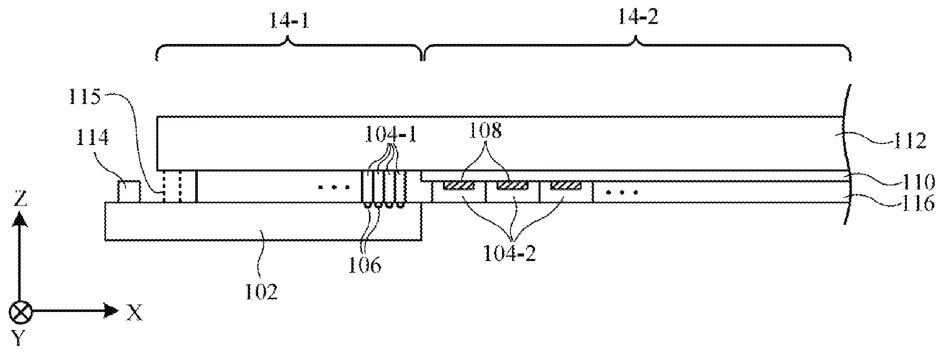
This patent describes a screen made of two distinct parts: a high-resolution center and a lower-resolution edge. The high-resolution section uses a silicon base to pack more pixels into the main viewing area, while the edges use a standard plastic-like base. Both sections share the same light-emitting layer to ensure the screen looks uniform.
In the filing’s own words
A hybrid display may include different display portions with different resolutions. The high resolution display portion may be positioned in a main viewing area for the viewer whereas the low resolution display portion may be positioned in a peripheral viewing area. The high resolution display portion may have a silicon backplane. The low resolution display portion may have a different type of backplane such as a thin-film transistor backplane. The different display portions may optionally share a common organic light-emitting diode layer such that light is emitted from the same plane across both display portions. The high resolution display portion may emit light through a transparent window in the low resolution display portion. A high resolution display may also be formed by separately forming a frontplane and a backplane. Conductive attachment structures such as indium bumps may be used to mechanically and electrically connect the backplane to the frontplane.
What exactly they claim (claim 1)
1. An electronic device, comprising: a first display portion comprising a glass substrate and a first array of pixels, wherein the first array of pixels has a first pitch, wherein the first array of pixels is arranged in a light-emitting area, and wherein the first display portion has a transparent window that does not include any of the pixels of the first array of pixels; a second display portion comprising a silicon substrate and a second array of pixels, wherein the second array of pixels has a second pitch that is different than the first pitch and wherein the second array of pixels emits light through the transparent window of the first display portion; and at least one common organic light-emitting diode layer that forms part of both the first array of pixels and the second array of pixels.
Facts
- Company
- Apple (Apple Inc.)
- Official title
- Hybrid displays
- Patent number
- US12800928B2
- Application number
- 18671793
- Filed
- May 22, 2024
- Granted
- Nov 17, 2026
- Inventors
- 5
- Claims
- 20
Classified under
G02B 27/0172 Physics & computingH10K 59/127 Electricity & electronicsH10W 72/073 Electricity & electronicsG02B 2027/0123 Physics & computingG09G 2360/04 Physics & computingH10K 59/128 Electricity & electronicsMore from Apple in AR, VR & displays
- Apple patents AR glasses that zoom in on what you look at Sep 8, 2026
- Apple patents finger ring that controls VR with taps and waves Sep 15, 2026
- Apple patents head-mounted device that types via eye swipes and hand pinches Oct 6, 2026
- Apple patents eye-tracking and hand gestures to select screen items Oct 20, 2026
- Apple patents AR glasses that adjust lens spacing to fit your eyes Nov 3, 2026
Summaries are simplified from the filing’s own abstract and first claim. A patent filing is not a product announcement.
Patent data and drawings: U.S. Patent and Trademark Office (USPTO). Nebula is not affiliated with or endorsed by the USPTO.