Amazon patents Wi-Fi and ultrasound combo to better detect when you are home
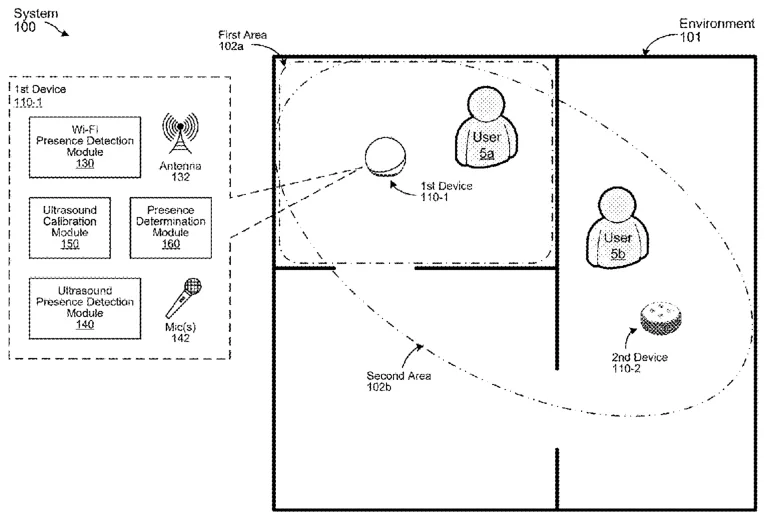
This patent describes a system that uses Wi-Fi signals to help an ultrasonic sensor in a device distinguish between actual movement and background noise. By checking if the room is empty using Wi-Fi data, the system can adjust the ultrasound settings to avoid false alarms from minor vibrations. It then uses these tuned settings to accurately detect when a person is present or has left the area.
In the filing’s own words
A system may use Wi-Fi channel state information (CSI) to configure ultrasonic presence detection (USPD) in a user device. Minor motion events in the vicinity of the user device may occur close to the noise floor of USPD such that noise transients can trigger false presence readings. In contrast, CSI can be highly sensitive to minor movements but may detect motion outside the area of interest; for example, in another room. Accordingly, the system may use CSI to confirm vacancy for purposes of tuning USPD. A first implementation of the system may use CSI to configure conditions for USPD-based state transitions in an adaptive state machine. A second implementation may use statistical methods to calculate parameters for detecting minor motion in USPD data. A third implementation may knowledge distillation techniques to transfer an embedding space from a network that processes CSI to a network that processes ultrasound data.
What exactly they claim (claim 1)
1. A computer-implemented method comprising: receiving first data representing channel state information corresponding to a Wi-Fi signal received by a first device from a second device during a first interval of time; determining that the first data indicates a vacancy of a first area corresponding to the first device and the second device; receiving, from an ultrasound sensor corresponding to the first device, second data corresponding to the first interval of time; determining, based on the first data and the second data, at least a first parameter for detecting minor motion using the ultrasound sensor; after determining the first parameter, receiving third data from the ultrasound sensor; determining that the third data represents at least a first event exceeding a first threshold for detection of major motion; in response to determining that the third data represents at least a first event exceeding the first threshold, outputting a first indication of presence in a second area corresponding to the first device; receiving, from the ultrasound sensor, fourth data corresponding to a second interval of time following receipt of the third data, the fourth data representing at least a second event exceeding a second threshold for detection of minor motion; determining, using the at least first parameter, that the fourth data indicates an absence of motion in the second area during the second interval of time; and in response to determining that the fourth data indicates an absence of motion in the second area during the second interval of time, outputting an indication of vacancy of the second area.
Facts
- Company
- Amazon (Amazon Technologies, Inc.)
- Official title
- Presence detection calibration
- Patent number
- US12784766B1
- Application number
- 19093876
- Filed
- Mar 28, 2025
- Granted
- Nov 3, 2026
- Inventors
- 6
- Claims
- 20
Classified under
G10L 25/78 Physics & computingG10L 15/22 Physics & computingH04B 17/21 Electricity & electronicsH04W 84/12 Electricity & electronicsMore from Amazon in Networks & wireless
- Amazon patents system to deliver data packets at exact same time Nov 3, 2026
- Amazon patents indoor map building using Wi-Fi signals Sep 29, 2026
- Amazon patents Wi-Fi backup that uses your phone when router dies Oct 6, 2026
- Amazon patents home mesh network for better wireless sensing Nov 3, 2026
- Amazon patents location tracking that hides exact gateway positions Nov 3, 2026
Summaries are simplified from the filing’s own abstract and first claim. A patent filing is not a product announcement.
Patent data and drawings: U.S. Patent and Trademark Office (USPTO). Nebula is not affiliated with or endorsed by the USPTO.