Samsung patents robot skin that feels nearby objects using sound
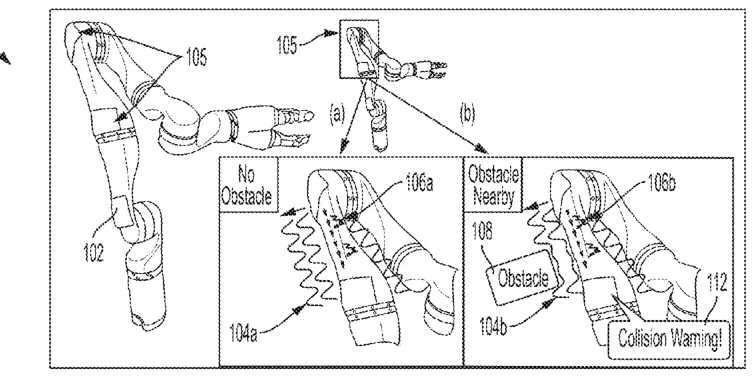
Samsung describes a system where tiny sensors attached to a robot's surface send out sound waves to detect nearby obstacles. The system filters the returning sound signals and uses a neural network to determine if an object is close enough to cause a collision.
In the filing’s own words
An apparatus for collision avoidance by surface proximity detection includes a plurality of piezoelectric elements disposed adjacent to a surface of an object, a memory storing instructions, and at least one processor configured to execute the instructions to control a first one among the piezoelectric elements to generate an acoustic wave along the surface of the object, and receive, via a second one among the piezoelectric elements, an acoustic wave signal corresponding to the generated acoustic wave. The at least one processor is further configured to execute the instructions to filter the received acoustic wave signal, using a band-pass filter for reducing noise of the received acoustic wave signal, obtain a proximity signal for proximity detection, from the filtered acoustic wave signal, using a linear time-invariant filter, and detect whether an obstacle is proximate to the surface of the object by inputting the obtained proximity signal into a neural network.
What exactly they claim (claim 1)
1. An apparatus for proximity detection of an obstacle relative to an object, the apparatus comprising: a plurality of piezoelectric elements attached to a surface of the object; a memory storing instructions; and at least one processor configured to execute the instructions to: control a first one among the plurality of piezoelectric elements to generate an acoustic wave along the surface of the object; receive, via a second one among the plurality of piezoelectric elements, an acoustic wave signal corresponding to an acoustic impedance change in an acoustic pressure field perturbed by the obstacle; filter the received acoustic wave signal, using a band-pass filter; obtain a signal for proximity detection, from the filtered acoustic wave signal; and detect whether the obstacle is adjacent to the surface of the object by inputting the obtained signal for proximity detection into a neural network.
Facts
- Company
- Samsung (SAMSUNG ELECTRONICS CO., LTD.)
- Official title
- Method and apparatus for robot collision avoidance by full surface proximity detection
- Patent number
- US12779711B2
- Application number
- 19241887
- Filed
- Jun 18, 2025
- Granted
- Nov 3, 2026
- Inventors
- 6
- Claims
- 20
Classified under
B25J 19/028 Operations & transportB25J 9/1666 Operations & transportB25J 13/086 Operations & transportB25J 13/089 Operations & transportG06N 3/04 Physics & computingMore from Samsung in Robots & automation
- Samsung patents robot that turns toward people based on who is speaking Oct 1, 2026
- Samsung patents robot vacuum that adjusts suction based on floor type Sep 8, 2026
- Samsung patents robot that adjusts hearing based on nearby objects Sep 8, 2026
- Samsung patents vacuum that senses floor type via pressure and motor load Sep 15, 2026
- Samsung patents robot that learns from user feedback on camera views Sep 15, 2026
Summaries are simplified from the filing’s own abstract and first claim. A patent filing is not a product announcement.
Patent data and drawings: U.S. Patent and Trademark Office (USPTO). Nebula is not affiliated with or endorsed by the USPTO.