Disney patents robot control that uses AI to stop shaking
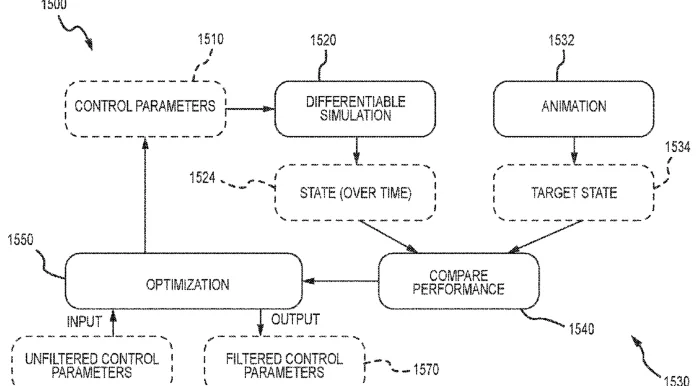
This patent describes a method for controlling robots to perform smooth movements without unwanted shaking. It uses a computer simulation to figure out how to adjust motor signals so the robot stays steady while following a specific motion path.
In the filing’s own words
In one example, a robotic system is disclosed that includes a plurality of components coupled together, a plurality of motors operable to move the plurality of components, a controller in electrical communication with the plurality of motors to generate control signals to actuate movement of the plurality of components, wherein the controller is configured to: receive a first set of control signals operative to generate a defined motion for the plurality of components, analyze the first set of control signals to determine a second set of control signals operative to define a retargeted motion for the plurality of components, wherein the retargeted motion suppresses vibrations of the plurality of components as compared to the defined motion, and provide the second set of control signals to the plurality of motors to actuate the retargeted motion by the plurality of components.
What exactly they claim (claim 1)
1. A method of controlling a robotic system comprising: simulating movement and vibration of the robotic system by providing unfiltered control parameters for the robotic system to a differentiable simulator to generate a first set of states of the robotic system over time; comparing the first set of states against an input animation; optimizing the unfiltered control parameters to suppress vibration of the robotic system and to minimize deviation of the first set of states from the input animation, thereby generating filtered control parameters; simulating movement and vibration of the robotic system by providing the filtered control parameters to the differentiable simulator to generate a second set of states of the robotic system over time; training a machine learning model utilizing training data comprising the unfiltered control parameters, the first set of states, the filtered control parameters, and the second set of states, wherein the unfiltered control parameters and the filtered control parameters are configured as associated pairs; generating a first set of control signals corresponding to an initial motion output based on an animation sequence to be performed by the robotic system; modifying, based on the machine learning model, the first set of control signals to generate a second set of control signals, wherein the second set of control signals corresponds to a retargeted motion output and suppresses vibration of the robotic system during performance of the animation sequence; and applying the second set of control signals to the robotic system to actuate the robotic system.
Facts
- Company
- Disney (DISNEY ENTERPRISES, INC.)
- Official title
- Real-time vibration-suppression control for robotic systems
- Patent number
- US12779677B2
- Application number
- 18200391
- Filed
- May 22, 2023
- Granted
- Nov 3, 2026
- Inventors
- 7
- Claims
- 19
Classified under
B25J 9/163 Operations & transportB25J 9/1669 Operations & transportMore from Disney in Robots & automation
- Disney patents suit frame that moves like a real muscle Nov 10, 2026
- Disney patents robot control that learns from human operators Sep 3, 2026
- Disney patents AI to predict robot movements using digital twins Nov 10, 2026
- Disney patents motion system for physical characters Nov 5, 2026
- Disney patents method to predict how objects fly off moving rides Oct 20, 2026
Summaries are simplified from the filing’s own abstract and first claim. A patent filing is not a product announcement.
Patent data and drawings: U.S. Patent and Trademark Office (USPTO). Nebula is not affiliated with or endorsed by the USPTO.