Samsung patents 6G method to let simple devices use less network power
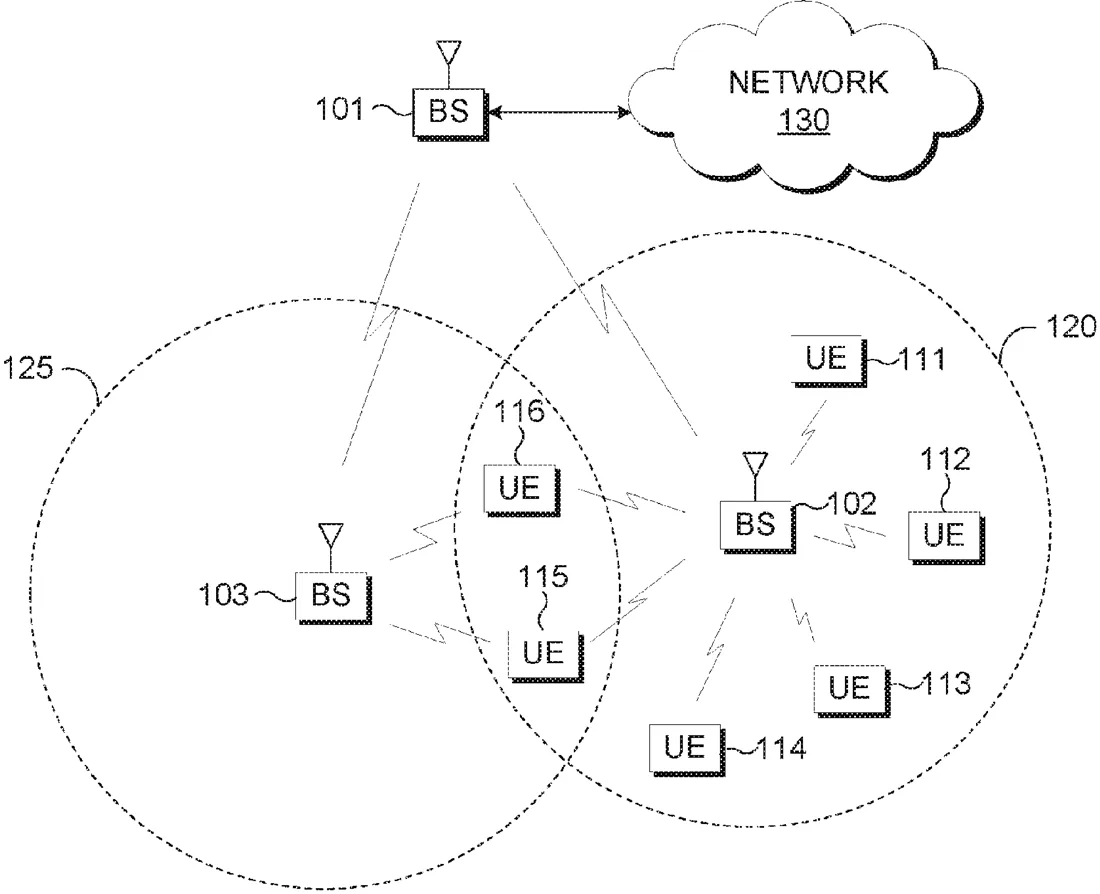
This filing describes a way for basic mobile devices to save battery by not listening to the entire radio signal. The device receives instructions on which specific parts of the signal to check, allowing it to ignore the rest and reduce its processing load.
In the filing’s own words
Apparatuses and methods for network-energy savings for reduced complexity operation for network access including for sixth generation (6G) radio access. A method performed by a user equipment includes receiving first information related to frequency-domain allocations associated with a downlink (DL) bandwidth for receptions or an uplink (UL) bandwidth for transmissions by a reduced bandwidth or complexity UE on a cell and receiving second information for a set of parameters associated with operation states on the cell. An operation state from the operation states includes parameters associated with receptions or transmissions of channels or signals on the cell. The method further includes receiving an indication for the operation state on the cell, determining, based on the indication, a first frequency-domain allocation for receptions or transmissions, and one of receiving a DL signal or channel or transmitting an UL signal or channel based on the first frequency-domain allocation.
What exactly they claim (claim 1)
1. A method of operating a user equipment (UE), the method comprising: receiving first information related to frequency-domain allocations associated with a downlink (DL) bandwidth for receptions or an uplink (UL) bandwidth for transmissions by a reduced bandwidth or complexity UE on a cell; receiving second information for a set of parameters associated with operation states on the cell, wherein an operation state from the operation states includes parameters associated with receptions or transmissions of channels or signals on the cell in at least one of a power, spatial, time, or frequency domain; receiving an indication for the operation state on the cell; determining, based on the indication, a first frequency-domain allocation for receptions or transmissions in one of (i) a carrier bandwidth or (ii) a frequency-domain allocation with lower and upper limits; and one of: receiving a DL signal or channel based on the first frequency-domain allocation, or transmitting an UL signal or channel based on the first frequency-domain allocation.
Facts
- Company
- Samsung (Samsung Electronics Co., Ltd.)
- Official title
- NETWORK-ENERGY SAVINGS FOR REDUCED COMPLEXITY OPERATION
- Publication number
- US20260333220A1
- Application number
- 19633733
- Filed
- Mar 30, 2026
- Published
- Oct 22, 2026
- Inventors
- 5
- Claims
- 18
Classified under
H04W 52/0229 Electricity & electronicsH04W 72/0453 Electricity & electronicsH04W 72/20 Electricity & electronicsH04W 76/28 Electricity & electronicsMore from Samsung in Networks & wireless
- Samsung patents UWB method to save power while tracking distance Sep 1, 2026
- Samsung patents system to keep satellite calls connected as satellites move Sep 1, 2026
- Samsung patents low-power IoT tags that reply without precise clocks Sep 1, 2026
- Samsung patents phone feature that switches networks to fix slow connections Sep 1, 2026
- Samsung patents satellite phone method for switching between signal types Sep 1, 2026
Summaries are simplified from the filing’s own abstract and first claim. A patent filing is not a product announcement.
Patent data and drawings: U.S. Patent and Trademark Office (USPTO). Nebula is not affiliated with or endorsed by the USPTO.