Samsung patents new material for solid oxide fuel cells
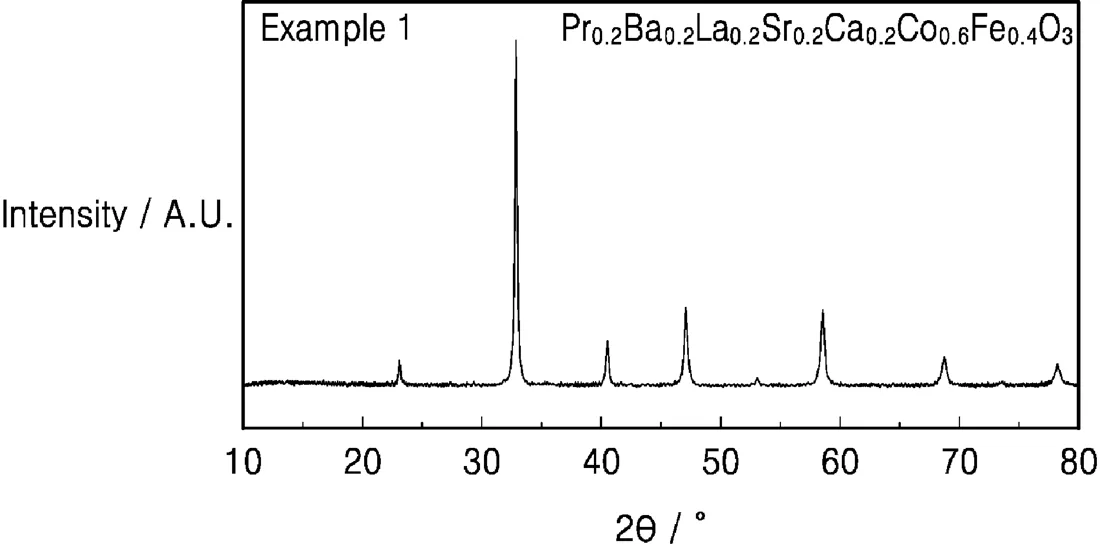
Samsung describes a specific metal oxide material designed to conduct ions in solid oxide fuel cells. The invention details a perovskite crystal structure where elements like barium, strontium, cobalt, and iron are arranged in precise ratios to improve performance. The filing also covers the method for manufacturing this conductor and its use in the electrodes or electrolyte layers of a cell.
In the filing’s own words
A solid ion conductor, a method of manufacturing the solid ion conductor, and a solid oxide cell in which at least one of an air electrode, a fuel electrode, or a solid electrolyte layer includes the solid ion conductor. The solid ion conductor includes a metal oxide having a perovskite structure, the metal oxide includes: four or more elements arranged in a cubooctahedral site of the perovskite structure, where the four or more different elements include i) barium, strontium, and M 1 and M 2 elements or ii) barium, strontium, and M 1, M 2 and M 3 elements; and cobalt and iron, or ii) cobalt, iron, and M 4, arranged in the octahedral site of the perovskite structure, M 1, M 2, M 3, and M 4, and molar content of elements barium, strontium, M 1, M 2, M 3, and M 4 areas defined, and a molar content of cobalt is equal to or greater than a molar content of iron.
What exactly they claim (claim 1)
1. A solid ion conductor comprising a metal oxide having a perovskite structure, wherein the metal oxide includes: four or more different elements arranged in a cubooctahedral site of the perovskite structure, where the four or more different elements include i) barium, strontium, and M 1 and M 2 elements, or ii) barium, strontium, and M 1, M 2 and M 3 elements; and cobalt and iron, or ii) cobalt, iron, and M 4, arranged in the octahedral site of the perovskite structure, wherein M 1 and M 2 are each independently a cation having an oxidation number of 3+, a lanthanide element, a group 3 element, a group 5 element, a group 8 element, a group 10 element, or a combination thereof, M 3 is a cation having an oxidation number 2+ or 3+, a group 2 element, a group 5 element, or a combination thereof, and M 4 is a transition metal having an oxidation number 2+ or 3+, a group 4 element, a group 7 element, a group 10 to 13 element, a group 16 element, or a combination thereof, and molar content of elements barium, strontium, M 1 and M 2 are each 0.5 or less with respect to a total moles of the elements barium, strontium, M 1 and M 2; or molar content of elements barium, strontium, M 1, M 2 and M 3 are each 0.5 or less with respect to a total of the elements barium, strontium, M 1, M 2 and M 3, and a molar content of cobalt is equal to or greater than a molar content of iron.
Facts
- Company
- Samsung (Samsung Electronics Co., Ltd.)
- Official title
- SOLID ION CONDUCTOR, METHOD OF MANUFACTURING THE SAME, AND SOLID OXIDE CELL INCLUDING THE SAME
- Publication number
- US20260331525A1
- Application number
- 19635128
- Filed
- Mar 31, 2026
- Published
- Oct 22, 2026
- Inventors
- 3
- Claims
- 20
Classified under
H01M 4/9033 Electricity & electronicsH01M 4/8882 Electricity & electronicsH01M 8/1213 Electricity & electronicsH01M 2008/1293 Electricity & electronicsMore from Samsung in Batteries & energy
- Samsung patents layered silicon coating for better lithium batteries Sep 1, 2026
- Samsung patents phone power-saving mode that pauses network checks Sep 8, 2026
- Samsung patents AI system that updates battery safety models when faults appear Sep 22, 2026
- Samsung patents new material for solid-state batteries Sep 29, 2026
- Samsung patents wireless charger that shows where your phone is charging Sep 29, 2026
Summaries are simplified from the filing’s own abstract and first claim. A patent filing is not a product announcement.
Patent data and drawings: U.S. Patent and Trademark Office (USPTO). Nebula is not affiliated with or endorsed by the USPTO.