Microsoft patents DNA sequencing fix for uncorrectable errors
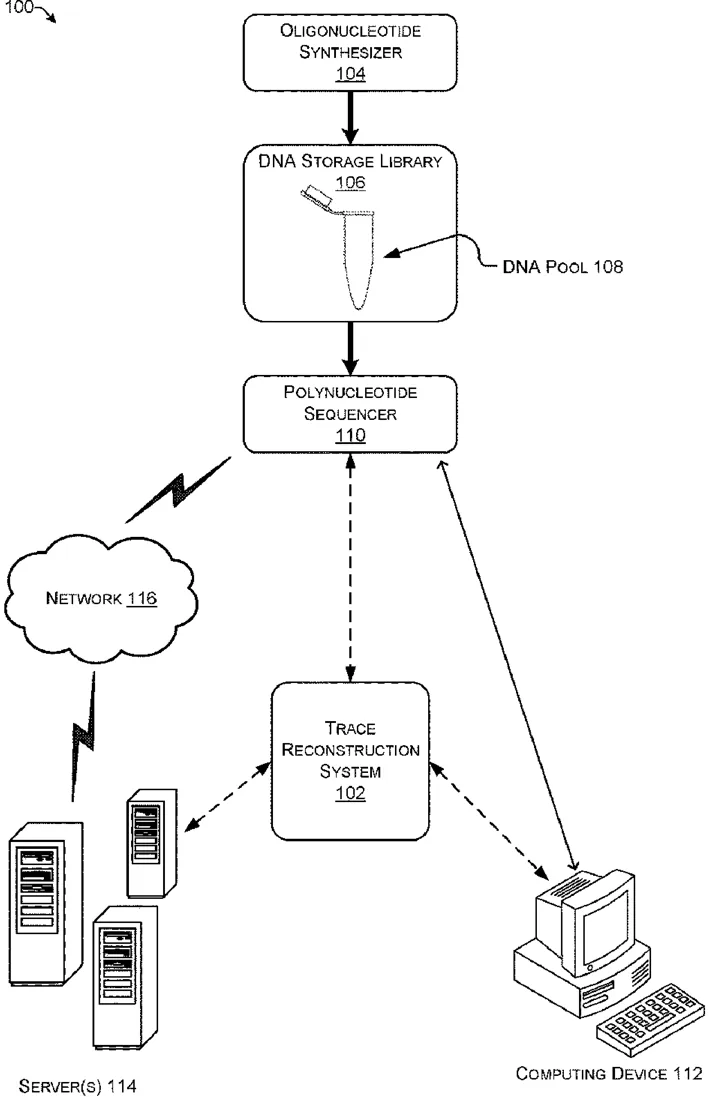
This filing describes a method for reconstructing DNA sequences when sequencing machines make errors that cannot be automatically fixed. Instead of discarding the entire data segment, the system skips the broken part and uses a matching section later in the sequence to realign the remaining data.
In the filing’s own words
Polynucleotide sequencing generates multiple reads of a polynucleotide molecule. Many or all of the reads contain errors. Trace reconstruction takes multiple reads generated by a polynucleotide sequencer and uses those multiple reads to reconstruct accurately the nucleotide sequence of the polynucleotide molecule. Some reads may contain errors that cannot be corrected. Thus, there may be reads that can be used throughout their entire length and other reads that have indeterminant errors which cannot be corrected. Rather than discarding the entire read when an indeterminant error is found, the portion of the read with the error is skipped and the sequence of the read following the error is used to reconstruct the trace. The amount of the read skipped is determined by the location of subsequence after the error that matches a consensus sequence of the other reads. Analysis resumes at a location determined by the location of the match.
What exactly they claim (claim 1)
1. A method for aligning sequence reads comprising: identifying an alignment anchor sequence having a predetermined sequence that is present in a first sequence read and in a second sequence read; dividing the first sequence read into a first sub-read that extends from a beginning of the first sequence read to the alignment anchor sequence and into a second sub-read that extends from the alignment anchor sequence to an end of the first sequence read; dividing the second sequence read into a third sub-read that extends from the beginning of the second sequence read to the alignment anchor sequence and into a fourth sub-read that extends from the alignment anchor sequence to the end of the second sequence read; aligning the first sub-read with the third sub-read based on the beginning of the first sequence read, the beginning of the second sequence read, and the alignment anchor sequence; and aligning the second sub-read with the fourth sub-read based on the alignment anchor sequence, the end of the first sequence read, and the end of the second sequence read.
Facts
- Company
- Microsoft (MICROSOFT TECHNOLOGY LICENSING, LLC)
- Official title
- TRACE RECONSTRUCTION FROM READS WITH INDETERMINANT ERRORS
- Publication number
- US20260331222A1
- Application number
- 19700248
- Filed
- Jun 6, 2026
- Published
- Oct 22, 2026
- Inventors
- 2
- Claims
- 20
Classified under
G16B 30/00 Physics & computingG06F 40/166 Physics & computingG06F 40/279 Physics & computingG16B 40/00 Physics & computingG16B 40/20 Physics & computingMore from Microsoft in Chips & hardware
- Microsoft patents chips with liquid cooling built inside Oct 1, 2026
- Microsoft patents chip design that guesses code steps ahead Sep 8, 2026
- Microsoft patents 3D glass storage using laser light patterns Sep 8, 2026
- Microsoft patents hand-held radar reflectors for tracking movement Sep 8, 2026
- Microsoft patents video boost that reuses old frames to save power Sep 15, 2026
Summaries are simplified from the filing’s own abstract and first claim. A patent filing is not a product announcement.
Patent data and drawings: U.S. Patent and Trademark Office (USPTO). Nebula is not affiliated with or endorsed by the USPTO.