Microsoft patents glass discs that use tension to write data faster
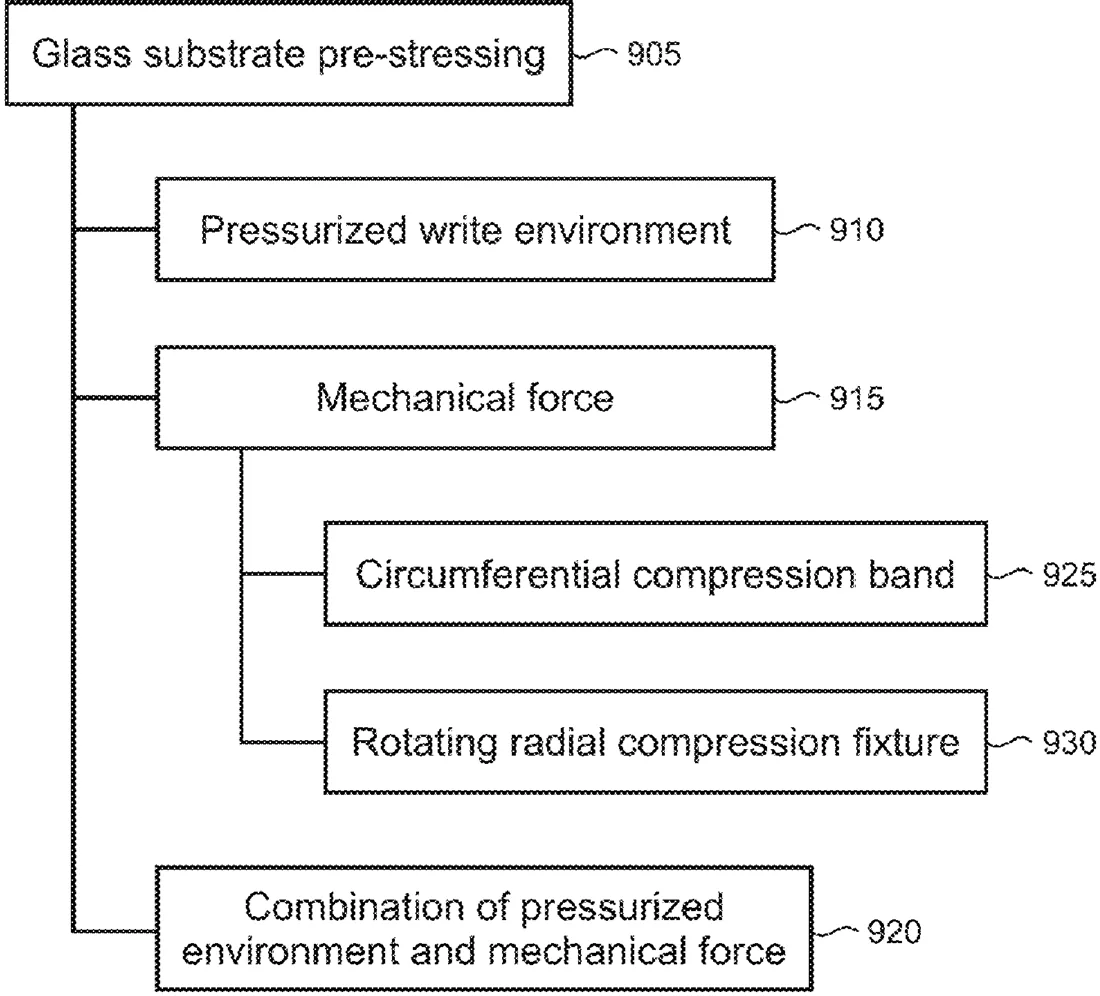
Microsoft describes a method for improving the speed of writing data to glass storage discs by applying pressure to the material. The filing explains that spinning the glass creates stress that can slow down laser writing, so the invention uses mechanical bands or gas pressure to squeeze the disc inward. This counteracts the stress, allowing the laser to write data more efficiently.
In the filing’s own words
Tensile stress in a glass substrate of an optical storage medium is reduced by pre-stressing the substrate in compression to counteract thermally- and inertially-induced tensile stresses experienced during write operations using a pulsed laser. In a first embodiment, a uniform compressive stress distribution is realized in the medium by performing write operations in an enclosure that is positively pressurized by a gas. In a second embodiment using a disc-shaped optical storage medium, compressive forces are directed radially inward using circumferentially-located mechanical engagement members. A third embodiment uses a metal tension strip that is heat-treated to induce tensile hoop stress in the strip. The metal tension strip functions as a circumferential compression band around a disc-shaped optical storage medium. Axially-directed forces can be applied to support the center of the disc in the second and third embodiments to mitigate against buckling from the radially-inward directed forces.
What exactly they claim (claim 1)
1. An optical storage medium arranged for embedding a plurality of voxels to store data, wherein data is written to the optical storage medium using a writing system having a laser that operates by producing pulses of irradiation while the optical storage medium rotates about a central axis during operations of the laser producing pulses of irradiation, the optical storage medium comprising: a disc-shaped body made of an optically transparent substrate to allow transmission of laser irradiation to interior locations within the body, the body comprising a planar central portion and an annular peripheral edge portion, wherein a thickness of the body is smaller relative to a radius of the planar central portion; and a tension strip, pre-stressed in tension and encircling the annular peripheral edge portion of the body as a circumferential compression band, providing substantially uniform radially-inward compressive stress throughout the body, wherein the compressive stress counteracts radial inertial stress in the body due to rotation of the optical storage medium.
Facts
- Company
- Microsoft (Microsoft Technology Licensing, LLC)
- Official title
- INCREASING WRITE SPEED OF OPTICAL DATA BY PRE-STRESSING GLASS STORAGE MEDIA
- Publication number
- US20260331136A1
- Application number
- 19183242
- Filed
- Apr 18, 2025
- Published
- Oct 22, 2026
- Inventors
- 2
- Claims
- 20
Classified under
G11B 7/24 Physics & computingG11B 7/24038 Physics & computingG11B 7/26 Physics & computingG11B 23/0035 Physics & computingG11B 33/1433 Physics & computingG11B 2007/0009 Physics & computingMore from Microsoft in Chips & hardware
- Microsoft patents chips with liquid cooling built inside Oct 1, 2026
- Microsoft patents chip design that guesses code steps ahead Sep 8, 2026
- Microsoft patents 3D glass storage using laser light patterns Sep 8, 2026
- Microsoft patents hand-held radar reflectors for tracking movement Sep 8, 2026
- Microsoft patents video boost that reuses old frames to save power Sep 15, 2026
Summaries are simplified from the filing’s own abstract and first claim. A patent filing is not a product announcement.
Patent data and drawings: U.S. Patent and Trademark Office (USPTO). Nebula is not affiliated with or endorsed by the USPTO.