Google patents faster error checking for quantum computers
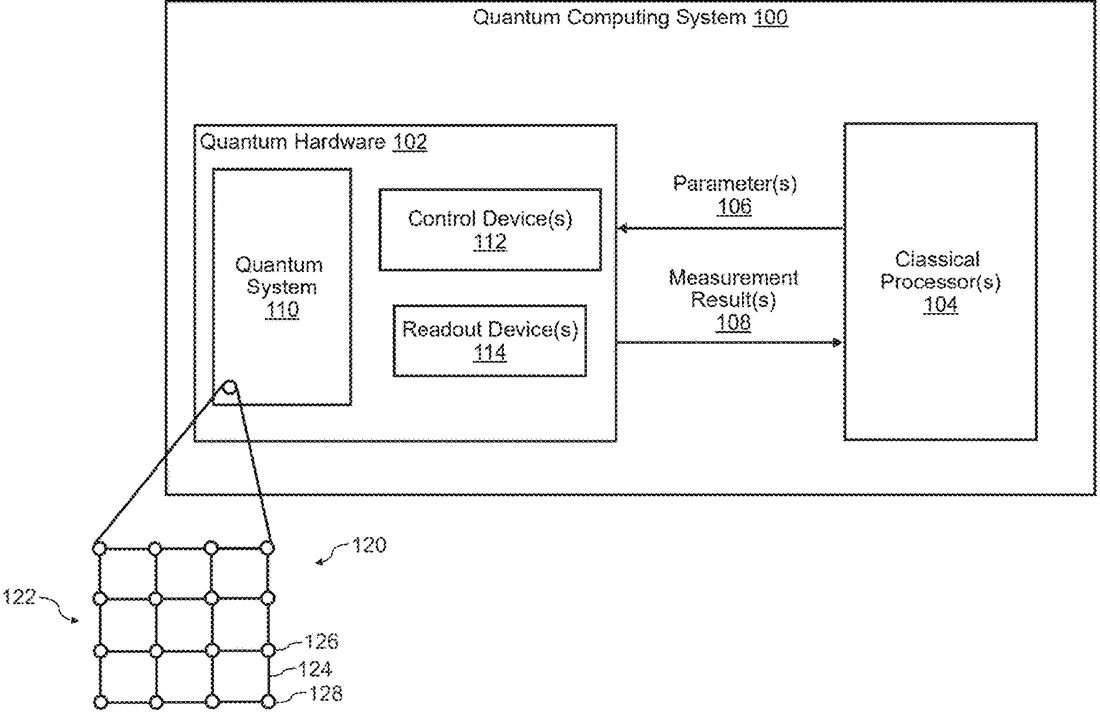
This filing describes a method for quantum computers to detect and fix errors in their calculations more efficiently. It splits the error-checking task among multiple standard processors working in parallel, allowing them to correct mistakes in real-time as the quantum computer runs.
In the filing’s own words
The disclosure is directed to a method performed during an execution of a quantum algorithm, via a quantum computing system (QCS) that includes a set of qubits and a set of classical processor devices. The quantum algorithm includes a quantum error correction (QEC) code that includes a set of qubit measurements over the set of qubits. Prior to the execution of the QA, the classical processor devices generate a matching graph (MG). During the execution of the quantum algorithm, the following operations are interleaved. A current subset of qubit measurements is performed. The qubit measurements are based on the QEC code. The classical processor devices update the MG based on values of the current subset of qubit measurements. The set of classical processor devices decodes one or more qubit errors based on the updated MG.
What exactly they claim (claim 1)
1. A method for decoding an error syndrome measured during an execution, via a quantum computing system (QCS), of a quantum algorithm (QA), the method comprising: accessing a matching graph (MG) that includes a set of detection events that is encoded in the error syndrome, wherein the MG has been subdivided into a set of graph regions, the MG further includes a set of edges, and each edge of the set of edges having a weight, wherein each classical processor device of a set of classical processor devices of the QCS has been assigned to a separate subset of a set of detections events such that each classical processor device is assigned to a separate graph region of the set of graph regions that includes the assigned subset of detection events; for each classical processor device of the set of classical processor devices, reweighting one or more edges connected to one or more detection events of the classical processor device's assigned subset of detection events based on temporal or spatial correlations with one or more neighboring detection events of the set of detection events; identifying a set of quantum errors that occurred during the execution of the QA based on, for each classical processor device of the set of classical processor devices, performing a local matching algorithm based on detection events located in the graph region assigned to the classical processor device; and during the execution of the QA, performing one or more corrective actions, via the QCS, that correct at least a subset of the set of quantum errors.
Facts
- Company
- Google (Google LLC)
- Official title
- Parallel Matching for Quantum Error Correction
- Publication number
- US20260330286A1
- Application number
- 19468073
- Filed
- Feb 3, 2026
- Published
- Oct 22, 2026
- Inventors
- 1
- Claims
- 1
Classified under
G06N 10/70 Physics & computingG06N 10/00 Physics & computingMore from Google in Chips & hardware
- Google patents quantum gates to simulate particle physics Sep 1, 2026
- Waymo patents lidar chips that split light into multiple beams Sep 8, 2026
- Google patents chip design to speed up AI math tasks Sep 8, 2026
- Google patents display that turns off colors to save battery Sep 8, 2026
- Google patents display tech that skips blank screen areas to save power Sep 15, 2026
Summaries are simplified from the filing’s own abstract and first claim. A patent filing is not a product announcement.
Patent data and drawings: U.S. Patent and Trademark Office (USPTO). Nebula is not affiliated with or endorsed by the USPTO.