Microsoft patents method to pick best answers for training AI models
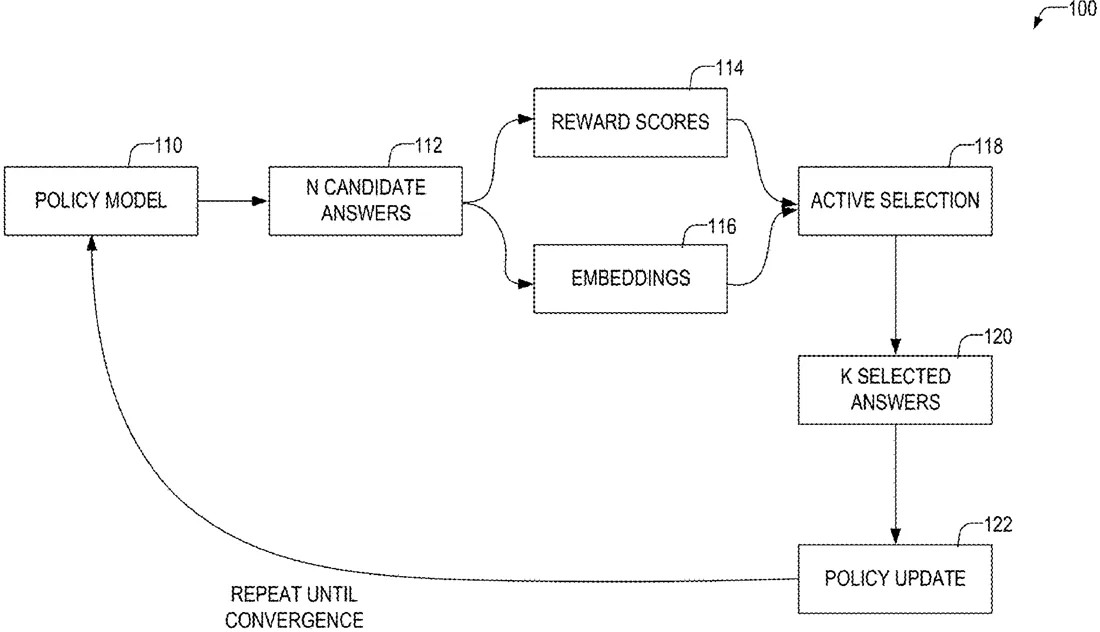
Microsoft describes a technique called Active Multi-Preference Optimization (AMPO) for training language models. The system generates many possible answers to a question, then uses scoring and grouping strategies to select only the most useful examples for learning. It calculates a specific loss function based on these selected answers to update the model's parameters more efficiently.
In the filing’s own words
This invention relates to a method and system for Active Multi-Preference Optimization (AMPO) in training language models. The method involves generating multiple candidate responses for a given query and selecting a subset of responses that are most informative for training. The selection process includes identifying a highest-reward response as a positive example and employing strategies such as clustering and weighted selection to choose negative responses. The selected responses are used to compute a weighted contrastive loss function, which updates the model's parameters to improve alignment with human preferences. This approach enhances training efficiency by reducing computational overhead and improving model performance through targeted data selection and optimization.
What exactly they claim (claim 1)
1. A computer-implemented method for training a language model, comprising: identifying N candidate responses for an input query; identifying reward scores for each of the N candidate responses; selecting K responses from the N candidate responses, where K is less than N by: identifying a highest-reward response as a positive example; and selecting K−1 negative responses from remaining responses by one or more of: selecting remaining responses with the lowest reward scores; applying clustering to group the remaining responses based on corresponding embedding vectors and selecting a response from each cluster with a lowest reward score; or selecting responses by weighting responses and assigning higher weights to responses with lower rewards, and selecting a subset of K−1 responses that minimizes weighted distances between responses while ensuring selected responses are semantically distinct from each other by selecting responses from different regions of an embedding space that clusters vector representations corresponding to the remaining responses based upon the weights; calculating a mean reward score from the reward scores of the K selected responses; computing deviations of each selected response's reward score from the mean reward score; partitioning the K selected responses into positive and negative groups by assigning responses with deviations above the mean reward score to the positive group, and assigning responses with deviations below or equal to the mean reward score to the negative group; assigning weights to each response based on its deviation from the mean reward score, wherein: responses with larger absolute deviations from the mean reward score are assigned higher weights than responses with smaller absolute deviations; computing modified scores for each response by combining a base score with the assigned weight; generating a weighted contrastive loss function based on the modified scores of the responses in the positive and negative groups; and updating parameters of the language model by optimizing the weighted contrastive loss function.
Facts
- Company
- Microsoft (Microsoft Technology Licensing, LLC)
- Official title
- ACTIVE MULTI-PREFERENCE OPTIMIZATION FOR TRAINING OF MACHINE LEARNING MODELS
- Publication number
- US20260330232A1
- Application number
- 19181584
- Filed
- Apr 17, 2025
- Published
- Oct 22, 2026
- Inventors
- 4
- Claims
- 21
Classified under
G06N 3/088 Physics & computingMore from Microsoft in AI & software
- Microsoft patents method to check AI answers against verified facts Oct 20, 2026
- Microsoft patents AI that presents PowerPoint slides for you Sep 3, 2026
- Microsoft patents method to check if LLM answers are based on real data Sep 10, 2026
- Microsoft patents system to blend multiple AI agents into one chat Oct 1, 2026
- Microsoft patents system that answers questions using your screen history Oct 15, 2026
Summaries are simplified from the filing’s own abstract and first claim. A patent filing is not a product announcement.
Patent data and drawings: U.S. Patent and Trademark Office (USPTO). Nebula is not affiliated with or endorsed by the USPTO.