Microsoft patents tool that finds errors in data tables automatically
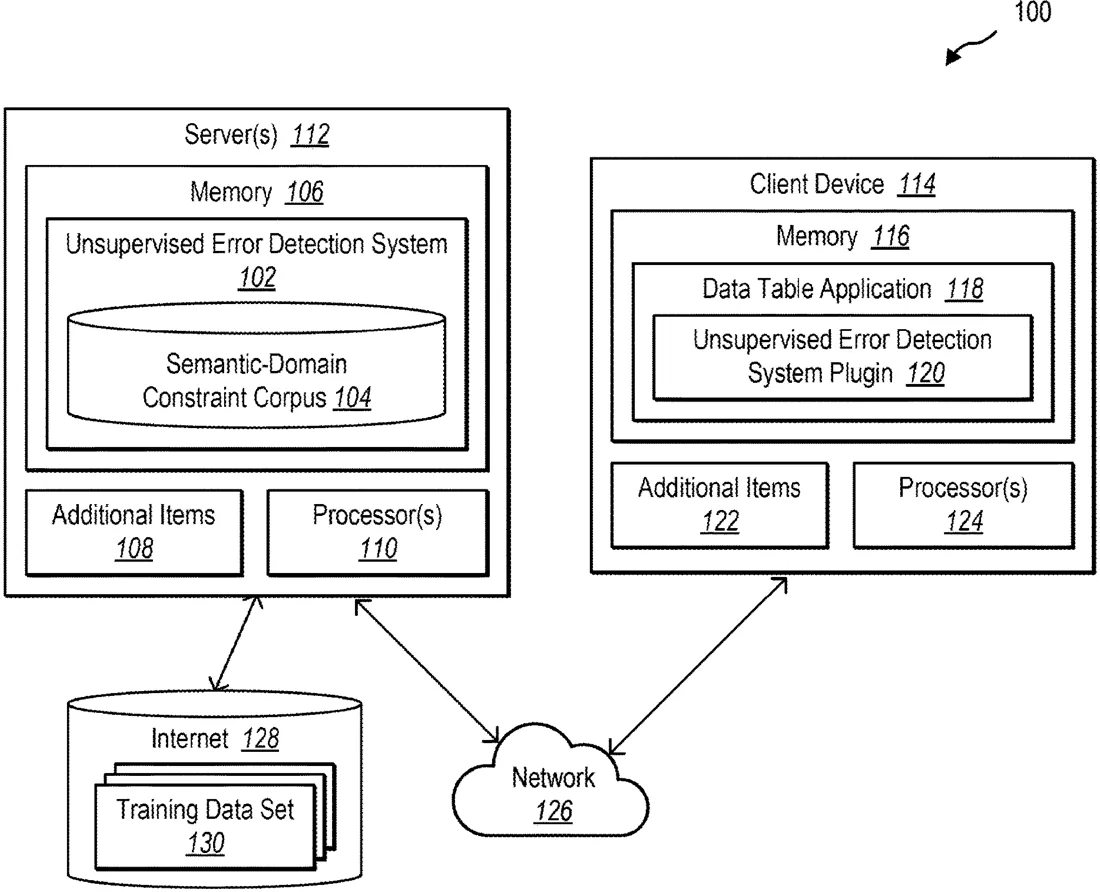
Microsoft describes a system that automatically checks data tables for mistakes without needing experts to set rules for each specific file. It learns what valid data looks like from large sets of examples and flags cells that break these general patterns.
In the filing’s own words
Systems and methods discussed herein generate a semantic-domain constraint corpus that detects data errors within columns of any data table, without requiring domain-experts to manually specify constraints on a per-table basis. A large body of semantic-domain constraint candidates is generated from test datasets, after which high-quality constraints within those candidates are identified. The systems and methods further pare the remaining semantic-domain constraints down based on size and false-positive rate constraints. The resulting semantic-domain constraint corpus can be applied to any structured dataset to automatically detect errors within columns of that dataset.
What exactly they claim (claim 1)
1. A data-quality system, comprising: at least one processor; and memory storing instructions that, when executed by the at least one processor, cause the system to: generate a plurality of semantic-domain constraint candidates by applying one or more semantic column-type detection methods to columns of a plurality of training data tables, each semantic-domain constraint candidate specifying a domain type, a pre-condition, and a post-condition for identifying errors within an unlabeled column domain; select a subset of semantic-domain constraints from the plurality of semantic-domain constraint candidates based on each selected semantic-domain constraint satisfying (i) a size constraint requiring the semantic-domain constraint to apply to at least a threshold number of columns of the plurality of training data tables, and (ii) a false-positive-rate constraint requiring an estimated false-positive rate of the semantic-domain constraint, measured over the plurality of training data tables, to be below a predetermined threshold; apply the subset of semantic-domain constraints to columns of a target data table to identify one or more cells of the target data table that violate at least one semantic-domain constraint of the subset; and cause a user interface to display a rendering of the target data table in which the identified one or more cells are visually distinguished from non-violating cells.
Facts
- Company
- Microsoft (Microsoft Technology Licensing, LLC)
- Official title
- UNSUPERVISED ERROR DETECTION IN DATA TABLES USING SEMANTIC-DOMAIN CONSTRAINTS
- Publication number
- US20260329827A1
- Application number
- 19730154
- Filed
- Jul 2, 2026
- Published
- Oct 22, 2026
- Inventors
- 7
- Claims
- 20
Classified under
G06F 16/215 Physics & computingMore from Microsoft in AI & software
- Microsoft patents method to check AI answers against verified facts Oct 20, 2026
- Microsoft patents AI that presents PowerPoint slides for you Sep 3, 2026
- Microsoft patents method to check if LLM answers are based on real data Sep 10, 2026
- Microsoft patents system to blend multiple AI agents into one chat Oct 1, 2026
- Microsoft patents system that answers questions using your screen history Oct 15, 2026
Summaries are simplified from the filing’s own abstract and first claim. A patent filing is not a product announcement.
Patent data and drawings: U.S. Patent and Trademark Office (USPTO). Nebula is not affiliated with or endorsed by the USPTO.