Microsoft patents AI tool that adjusts data logging based on service health
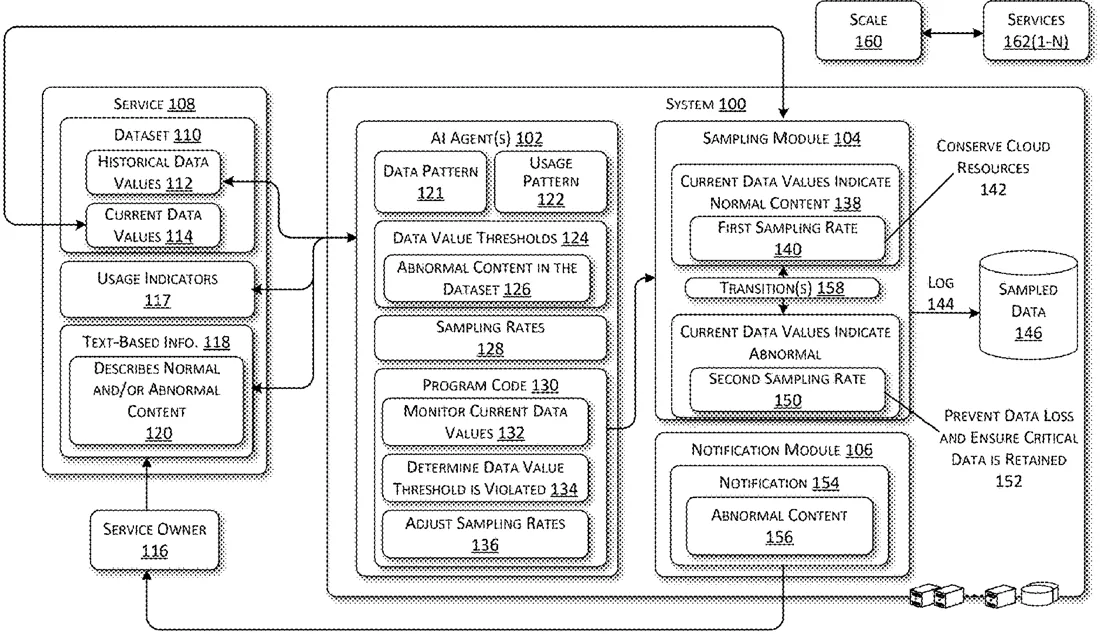
Microsoft describes a system that uses AI agents to create code for monitoring service data. The system lowers the rate of data logging when services run normally and increases it when issues are detected to save storage space.
In the filing’s own words
The techniques describe dynamic content-aware data sampling that adjusts a sampling rate of data associated with a service based on the content of the data. More specifically, if the data to be logged indicates that the service is operating normally, then the sampling rate is adjusted lower as the logged data has limited purpose provided the service is likely not experiencing an issue. In contrast, if the data indicates that the service is operating abnormally, then the sampling rate is adjusted higher as the logged data has elevated purpose provided the service may be experiencing an issue. The dynamic content-aware data sampling is implemented using program code generated by an artificial intelligence agent (e.g., a generative language model) based on service owner requirements, as well as historical data patterns and/or usage patterns.
What exactly they claim (claim 1)
1. A method comprising: accessing historical data values in a dataset associated with a service; accessing text-based information describing at least one of normal content or abnormal content in the dataset associated with the service; providing the historical data values in the dataset associated with the service and the text-based information to one or more artificial intelligence agents, wherein the one or more artificial intelligence agents are tuned to: interpret service owner requirements based on the text-based information; recognize data patterns in the historical data values in the dataset associated with the service; determine, based on the service owner requirements, one or more data value thresholds useable to detect the abnormal content in the dataset associated with the service, wherein the one or more data value thresholds adjust based on the patterns recognized in the historical data values in the dataset associated with the service; define sampling rates in accordance with normal content and abnormal content; and generate program code useable to monitor current data values in the dataset associated with the service, to determine if any one of the current data values violates the one or more data value thresholds, and to adjust the sampling rates in accordance with the normal content and the abnormal content; receiving, from the one or more artificial intelligence agents, the program code useable to monitor the current data values in the dataset associated with the service and to determine any of the current data values violates the one or more data value thresholds; monitoring, via execution of the program code, the current data values in the dataset associated with the service; sampling, via execution of the program code, a first group of the current data values in the dataset associated with the service at a first rate in response to the monitoring indicating normal content in the dataset associated with the service, wherein the normal content is indicated by each current data value in the first group of the current values not violating the one or more data value thresholds; logging, via execution of the program code, sampled data values from the first group of the current data values in a sampling cache that is made available to issue identification and mitigation components deployed for the service; sampling, via execution of the program code, a second group of the current data values in the dataset associated with the service at a second rate in response to the monitoring indicating abnormal content in the dataset associated with the service, wherein the abnormal content is indicated by a current data value in the second group of the current values violating the one or more data value thresholds and the second rate is greater than the first rate; and logging, via execution of the program code, sampled data values from the second group of the current data values in the sampling cache made available to the issue identification and mitigation components deployed for the service.
Facts
- Company
- Microsoft (MICROSOFT TECHNOLOGY LICENSING, LLC)
- Official title
- DYNAMIC CONTENT-AWARE DATA SAMPLING
- Publication number
- US20260329679A1
- Application number
- 19181766
- Filed
- Apr 17, 2025
- Published
- Oct 22, 2026
- Inventors
- 3
- Claims
- 20
Classified under
G06F 11/004 Physics & computingG06F 2201/81 Physics & computingMore from Microsoft in AI & software
- Microsoft patents method to check AI answers against verified facts Oct 20, 2026
- Microsoft patents AI that presents PowerPoint slides for you Sep 3, 2026
- Microsoft patents method to check if LLM answers are based on real data Sep 10, 2026
- Microsoft patents system to blend multiple AI agents into one chat Oct 1, 2026
- Microsoft patents system that answers questions using your screen history Oct 15, 2026
Summaries are simplified from the filing’s own abstract and first claim. A patent filing is not a product announcement.
Patent data and drawings: U.S. Patent and Trademark Office (USPTO). Nebula is not affiliated with or endorsed by the USPTO.