Samsung patents 6G method to split network bandwidth between devices
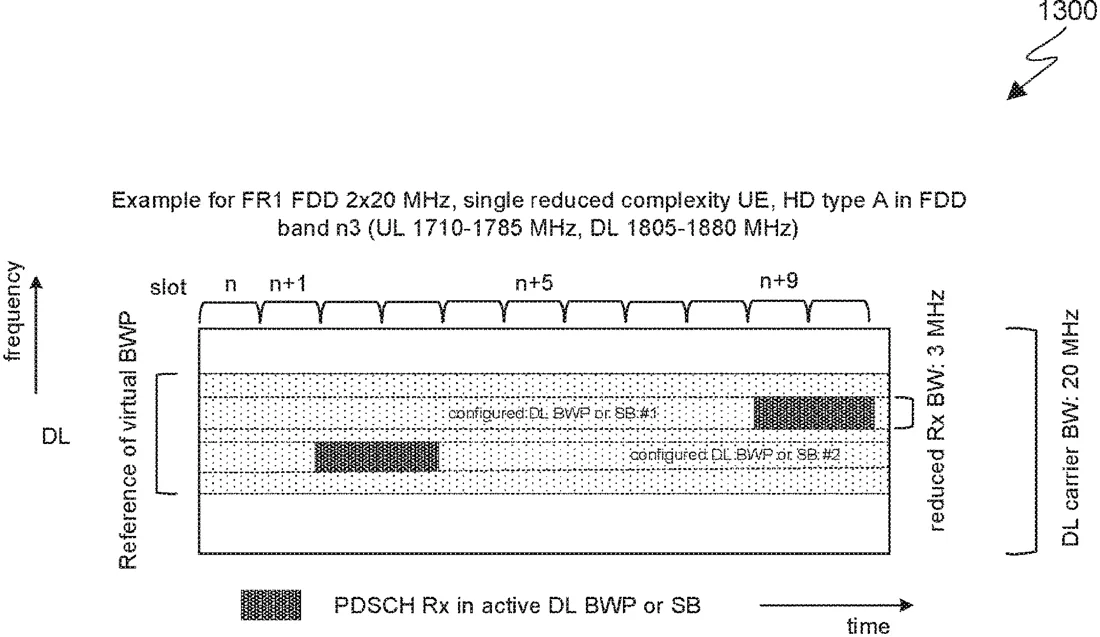
Samsung has filed a patent application describing how future 6G networks can manage data channels for different types of devices. The method allows a standard phone to calculate its own data lane by subtracting the specific lanes reserved for simpler, lower-power devices from the total available bandwidth.
In the filing’s own words
Apparatuses and methods for resource allocation for network access including for sixth generation (6G) radio access. A method performed by a user equipment includes receiving first information for a first parameters for a first frequency-domain allocation associated with a downlink (DL) bandwidth for receptions on a cell, receiving second information for a second parameters for a second frequency-domain allocation associated with a DL bandwidth for receptions by a reduced bandwidth/complexity UE on the cell, and determining a third frequency-domain allocation associated with a DL bandwidth for receptions on a symbol by excluding a resource block (RB)/a resource block group (RBG) from a second set of RBs/RBGs of the second frequency-domain allocation from a first set of RBs or RBGs of the first frequency-domain allocation. The method further includes one of receiving an RB/RBG in of the first or third frequency-domain allocation on the symbol on the cell.
What exactly they claim (claim 1)
1. A method of operating a user equipment (UE), the method comprising: receiving first information for a first set of parameters for a first frequency-domain allocation associated with a downlink (DL) bandwidth for receptions on a cell; receiving second information for a second set of parameters for a second frequency-domain allocation associated with a DL bandwidth for receptions by a reduced bandwidth or a reduced complexity UE on the cell; determining a third frequency-domain allocation associated with a DL bandwidth for receptions on a symbol by excluding a resource block (RB) or a resource block group (RBG) from a second set of RBs or RBGs of the second frequency-domain allocation from a first set of RBs or RBGs of the first frequency-domain allocation, wherein: the first set of RBs of RBGs of the first frequency-domain allocation corresponds to a set of RBs or RBGs based on one of a carrier bandwidth, a bandwidth part (BWP), or a frequency-domain allocation with upper and lower limits, and the second set of RBs or RBGs of the second frequency-domain allocation corresponds to a subset of the first RBs or RBGs of the first frequency-domain allocation; and one of: receiving an RB or RBG of the third frequency-domain allocation on the symbol on the cell when reception on the second frequency-domain allocation is not enabled for the UE; or receiving an RB or RBG of the first frequency-domain allocation on the symbol on the cell when reception on the first or second frequency-domain allocation is enabled for the UE.
Facts
- Company
- Samsung (Samsung Electronics Co., Ltd.)
- Official title
- RESOURCE ALLOCATION FOR NETWORK ACCESS
- Publication number
- US20260323675A1
- Application number
- 19577211
- Filed
- Mar 24, 2026
- Published
- Oct 15, 2026
- Inventors
- 5
- Claims
- 18
Classified under
H04W 72/51 Electricity & electronicsH04L 5/0094 Electricity & electronicsH04W 72/0453 Electricity & electronicsMore from Samsung in Networks & wireless
- Samsung patents UWB method to save power while tracking distance Sep 1, 2026
- Samsung patents system to keep satellite calls connected as satellites move Sep 1, 2026
- Samsung patents low-power IoT tags that reply without precise clocks Sep 1, 2026
- Samsung patents phone feature that switches networks to fix slow connections Sep 1, 2026
- Samsung patents satellite phone method for switching between signal types Sep 1, 2026
Summaries are simplified from the filing’s own abstract and first claim. A patent filing is not a product announcement.
Patent data and drawings: U.S. Patent and Trademark Office (USPTO). Nebula is not affiliated with or endorsed by the USPTO.