Samsung patents method to manage signal priority in 5G/6G networks
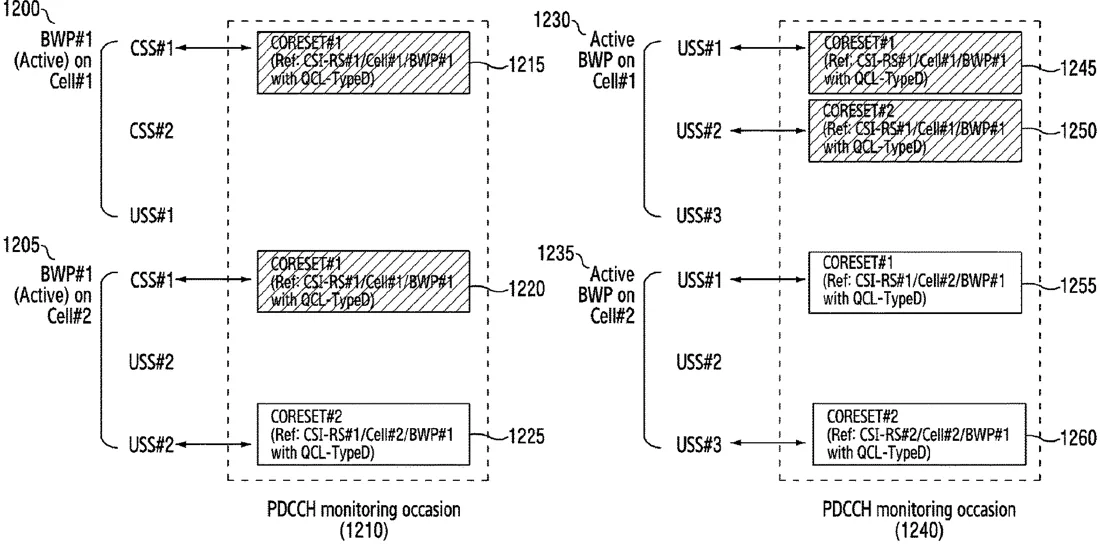
This filing describes a method for mobile devices to handle 'sounding reference signals' (SRS), which help base stations measure signal quality. It outlines how a device decides which of these signals to send or drop when they conflict with other urgent data transmissions or receptions.
In the filing’s own words
The present invention relates to a 5G or 6G communication system for supporting higher transmission rates. A method performed by a user equipment (UE) in a wireless communication system comprises the steps in which the UE: receives, from a base station, configuration information including information about a sounding reference signal (SRS) resource for transmitting an SRS signal through eight antenna ports, wherein the SRS resource includes at least two SRS transmission units respectively associated with at least two subsets of antenna ports included among the eight antenna ports; and transmits the SRS to the base station on the basis of the configuration information, the SRS being transmitted on a first subset of antenna ports associated with first SRS transmission units and a second subset of antenna ports associated with second SRS transmission units in each of the two SRS transmission units, wherein, when at least one SRS transmission unit among the first SRS transmission units or the second SRS transmission units overlaps at least one of aperiodic uplink transmission or aperiodic downlink reception, SRS transmissions for all or a portion of the first SRS transmission units and the second SRS transmission units may be dropped.
What exactly they claim (claim 1)
1. A method performed by a terminal (user equipment, UE) in a wireless communication system, the method comprising: receiving, from a base station, configuration information including information on a sounding reference signal (SRS) resource for transmitting an SRS by the terminal through eight antenna ports, the SRS resource including at least two SRS transmission occasions associated with at least two antenna port subsets included in the eight antenna ports, respectively; and based on the configuration information, transmitting, to the base station, the SRS on a first antenna port subset associated with a first SRS transmission occasion and a second antenna port subset associated with a second SRS transmission occasion in the at least two SRS transmission occasions, respectively, wherein, in case that at least one SRS transmission occasion among the first SRS transmission occasion or the second SRS transmission occasion overlaps at least one of an aperiodic uplink transmission or an aperiodic downlink reception, an SRS transmission for all or a part of the first SRS transmission occasion and the second SRS transmission occasion is dropped.
Facts
- Company
- Samsung (SAMSUNG ELECTRONICS CO., LTD.)
- Official title
- METHOD AND DEVICE FOR DETERMINING PRIORITY OF UPLINK REFERENCE SIGNAL IN WIRELESS COMMUNICATION SYSTEM
- Publication number
- US20260322554A1
- Application number
- 19142051
- Filed
- Dec 22, 2023
- Published
- Oct 15, 2026
- Inventors
- 4
- Claims
- 15
Classified under
H04L 5/0051 Electricity & electronicsH04W 72/231 Electricity & electronicsH04W 80/02 Electricity & electronicsMore from Samsung in Networks & wireless
- Samsung patents UWB method to save power while tracking distance Sep 1, 2026
- Samsung patents system to keep satellite calls connected as satellites move Sep 1, 2026
- Samsung patents low-power IoT tags that reply without precise clocks Sep 1, 2026
- Samsung patents phone feature that switches networks to fix slow connections Sep 1, 2026
- Samsung patents satellite phone method for switching between signal types Sep 1, 2026
Summaries are simplified from the filing’s own abstract and first claim. A patent filing is not a product announcement.
Patent data and drawings: U.S. Patent and Trademark Office (USPTO). Nebula is not affiliated with or endorsed by the USPTO.