Samsung patents 5G/6G data encoding method for faster transfers
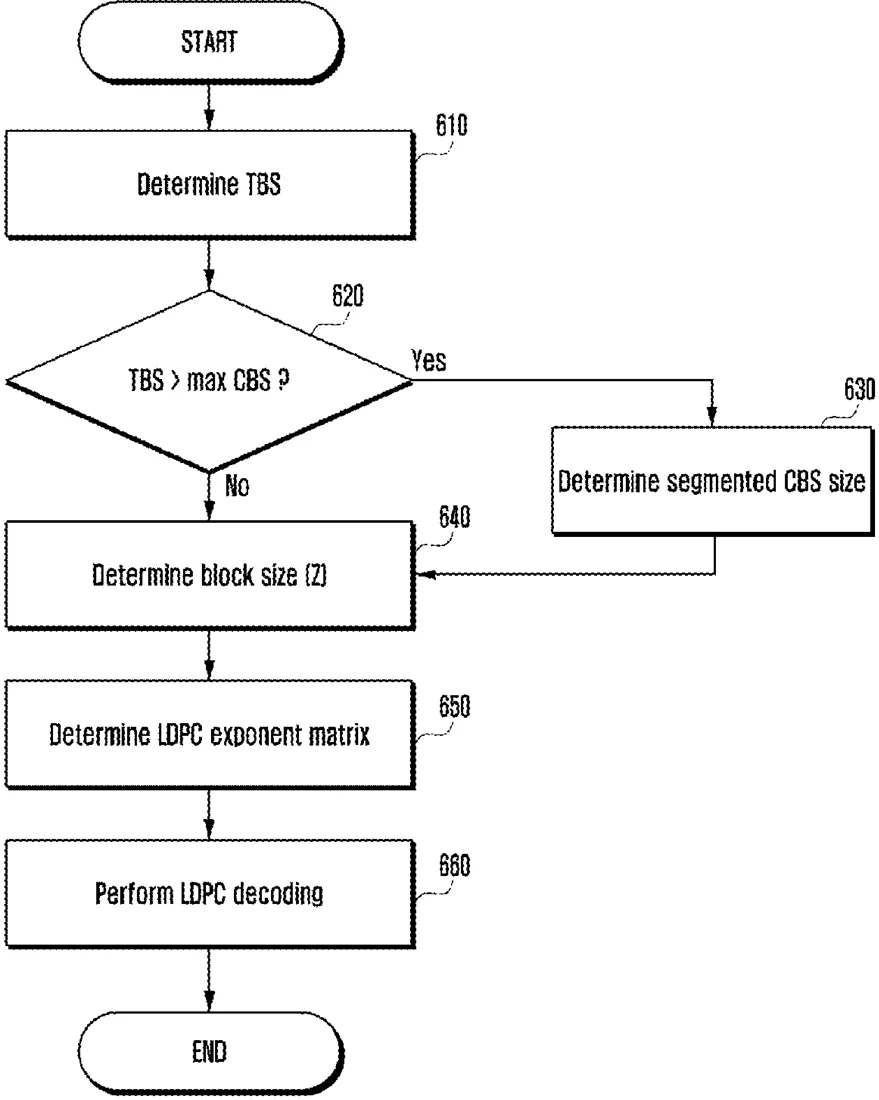
Samsung has filed a patent application for a specific way to encode data in 5G and 6G communication systems. The method involves calculating a 'parity check matrix' using mathematical rules based on the amount of data being sent, which helps ensure the information arrives correctly at the receiver.
In the filing’s own words
The present disclosure relates to a 5G or 6G communication system for supporting higher data transfer rates than 4G communication systems such as LTE. The present invention relates to a method performed by a transmitter in a communication system, the method comprising the steps of: determining the number of input bits; determining a base matrix on the basis of the number of input bits; determining a lifting size (Z) on the basis of at least one of the number of input bits or the base matrix; determining a parity check matrix on the basis of at least one of the base matrix and the lifting size (Z); and performing encoding on the basis of the parity check matrix and the input bits, wherein the parity check matrix includes a first submatrix corresponding to the input bits and a second submatrix corresponding to first parity bits, three cyclic permutation matrices are included in a first column block of the second submatrix, the greatest common divisor of at least one of difference values of each exponent of the cyclic permutation matrices and the lifting size (Z) is 1 or the smallest number greater than 1 among divisors of the lifting size (Z), and the at least one of the difference values of each exponent of the cyclic permutation matrices is Z/2 i (0≤i≤L), where Z=p*2 i (p is an odd number, 0≤i≤L).
What exactly they claim (claim 1)
1. A method performed by a transmitter in a communication system, the method comprising: determining a number of input bits; determining a base matrix, based on the number of the input bits; determining a lifting size (Z), based on at least one of the number of the input bits or the base matrix; determining a parity check matrix, based on at least one of the base matrix or the lifting size (Z); and performing encoding, based on the parity check matrix and the input bits, wherein the parity check matrix comprises a first submatrix corresponding to the input bits and a second submatrix corresponding to first parity bits, wherein a first column block of the second submatrix comprises three circulant permutation matrices, wherein a greatest common divisor of at least one of difference values of respective exponents of the circulant permutation matrices and the lifting size (Z) is 1 or a smallest number greater than 1 among divisors of the lifting size (Z), wherein at least one of the difference values of the respective exponents of the circulant permutation matrices is Z 2 i ( 0 ≤ i ≤ L), and wherein Z=p*2 i (P is an odd number, and 0≤i≤L).
Facts
- Company
- Samsung (Samsung Electronics Co., Ltd.)
- Official title
- METHOD AND APPARATUS FOR ENCODING AND DECODING DATA IN COMMUNICATION OR BROADCASTING SYSTEM
- Publication number
- US20260322534A1
- Application number
- 19556423
- Filed
- Mar 4, 2026
- Published
- Oct 15, 2026
- Inventors
- 1
- Claims
- 15
Classified under
H04L 1/0061 Electricity & electronicsMore from Samsung in Networks & wireless
- Samsung patents UWB method to save power while tracking distance Sep 1, 2026
- Samsung patents system to keep satellite calls connected as satellites move Sep 1, 2026
- Samsung patents low-power IoT tags that reply without precise clocks Sep 1, 2026
- Samsung patents phone feature that switches networks to fix slow connections Sep 1, 2026
- Samsung patents satellite phone method for switching between signal types Sep 1, 2026
Summaries are simplified from the filing’s own abstract and first claim. A patent filing is not a product announcement.
Patent data and drawings: U.S. Patent and Trademark Office (USPTO). Nebula is not affiliated with or endorsed by the USPTO.