Samsung patents 5G data transmission tweaks for IoT devices
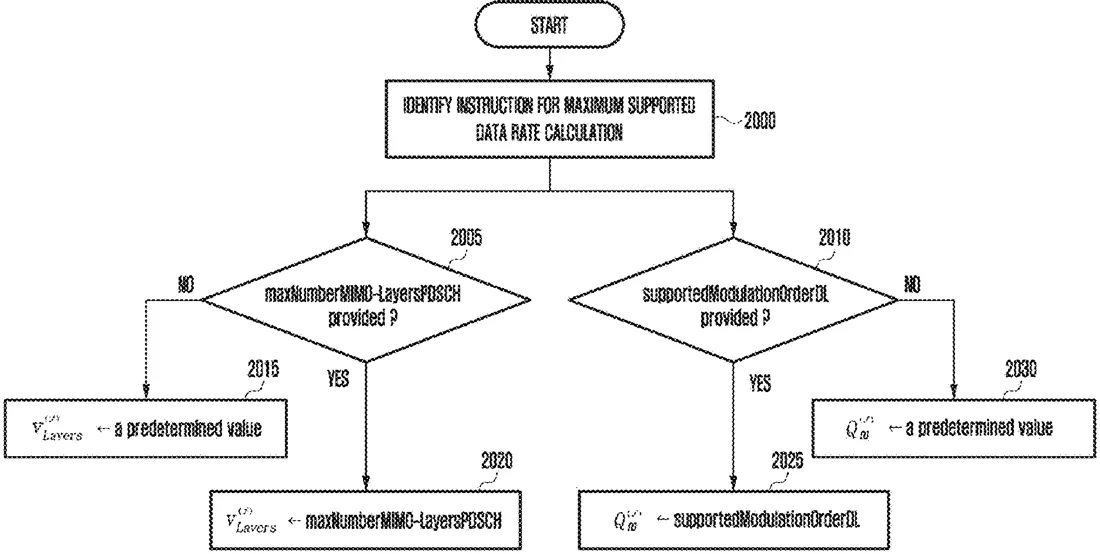
Samsung has filed a patent application describing a method for 5G terminals to manage data transmission when using limited buffer rate matching. The system allows devices to adjust how they encode and send data based on specific settings received from the base station, such as the type of modulation used. This helps ensure reliable communication for Internet of Things applications like smart homes and connected cars.
In the filing’s own words
The present disclosure relates to a communication method and system for converging a 5th-Generation (5G) communication system for supporting higher data rates beyond a 4th-Generation (4G) system with a technology for Internet of Things (IoT). The present disclosure may be applied to intelligent services based on the 5G communication technology and the IoT-related technology, such as smart home, smart building, smart city, smart car, connected car, health care, digital education, smart retail, security and safety services. A method and apparatus according to an embodiment may allow a terminal or a base station to configure parameters for supporting limited buffer rate matching (LBRM) by using higher layer signaling or enable a suitable configuration to be made in a case of not configuring parameters for supporting the LBRM using the higher layer signaling.
What exactly they claim (claim 1)
1. A method performed by a terminal in a communication system, the method comprising: identifying that an uplink limited buffer rate matching (LBRM) is applied; receiving, from a base station, a bandwidth part (BWP) configuration for each of a plurality of BWPs of a serving cell in higher layer signaling, each BWP configuration indicating a type of modulation and coding scheme (MCS) table associated with a physical uplink shared channel (PUSCH) for a corresponding BWP of the serving cell; encoding information bits to be transmitted to the base station using a low-density parity-check (LDPC) code; identifying a length of a circular buffer N cb based on a transport block size (TBS) for the uplink LBRM; determining a bit sequence based on the N cb and the encoded information bits; and transmitting, to the base station, the bit sequence, wherein the TBS for the uplink LBRM is identified based on an uplink maximum modulation order, wherein the uplink maximum modulation order for the serving cell corresponds to 8, in case that at least one type of MCS table for at least one BWP among the plurality of BWPs of the serving cell corresponds to 256QAM, and wherein the uplink maximum modulation order for the serving cell corresponds to 6, in case that all types of MCS table for the plurality of BWPs of the serving cell correspond to 64QAM.
Facts
- Company
- Samsung (Samsung Electronics Co., Ltd.)
- Official title
- METHOD AND APPARATUS FOR TRANSMISSION OR RECEPTION OF DATA IN COMMUNICATION SYSTEM
- Publication number
- US20260322533A1
- Application number
- 19442576
- Filed
- Jan 7, 2026
- Published
- Oct 15, 2026
- Inventors
- 4
- Claims
- 16
Classified under
H04L 1/0061 Electricity & electronicsH04L 1/0003 Electricity & electronicsH04L 1/0013 Electricity & electronicsH04L 1/1835 Electricity & electronicsH04L 5/0092 Electricity & electronicsH04L 27/362 Electricity & electronicsMore from Samsung in Networks & wireless
- Samsung patents UWB method to save power while tracking distance Sep 1, 2026
- Samsung patents system to keep satellite calls connected as satellites move Sep 1, 2026
- Samsung patents low-power IoT tags that reply without precise clocks Sep 1, 2026
- Samsung patents phone feature that switches networks to fix slow connections Sep 1, 2026
- Samsung patents satellite phone method for switching between signal types Sep 1, 2026
Summaries are simplified from the filing’s own abstract and first claim. A patent filing is not a product announcement.
Patent data and drawings: U.S. Patent and Trademark Office (USPTO). Nebula is not affiliated with or endorsed by the USPTO.